| Scholar |
Quotation
Used in Support of NWT |
What
the Scholar Really Said |
| William
Barclay |
"theos
[in John 1:1c] becomes a description, and more of an adjective than a
noun...[John] does not say that Jesus was God" (Barclay, Many
Witnesses, One Lord, p. 23 - 24).
-
The Watchtower, May 15, 1977, p. 320
|
When
Barclay says that John didn't write that "Jesus was God," he
merely means that Jesus was not God the Father. That Barclay sees
an ontological unity between ho theos and ho logos is
apparent in the following passage omitted from the Watchtower article:
"The only modern translator who
fairly and squarely faced this problem is Kenneth Wuest, who said: 'The
Word was as to his essence, essential deity.' But it is here that
the NEB has brilliantly solved the problem with the absolutely correct
rendering: 'What God was the Word was'" (Barclay, p. 23).
Barclay also makes his position clear in
a response to the Watchtower's citation:
"The Watchtower article has, by
judicious cutting, made me say the opposite of what I meant to
say. What I was meaning to say, as you well know, is that Jesus is
not the same as God, to put it more crudely, that is of the same stuff
as God, that is of the same being as God, but the way the Watchtower has
printed my stuff has simply left the conclusion that Jesus is not God in
a way that suits themselves. If they missed from their answer the
translation of Kenneth Wuest and the N.E.B., they missed the whole
point" (A letter to Donald P. Shoemaker, 8/26/1977.) ADDITIONAL
NOTE: It has been brought to my attention that William Barclay
"lied" when stating the following about Jn 1:1:
The deliberate distortion of truth by
this sect is seen in their New Testament translations. Jn 1:1 is
translated : ‘Originally the Word was, and the Word was with
God, and the Word was a god,’ a translation which is
grammatically impossible. [Col 2:1-17 is translated : ‘He
is the image of the invisible God, the firstborn of all creation,
because by means of him all other things were created... All other
things have been created through him and for him. Also he is before
all other things and by means of him all other things were made to
exist.’ Four times the word other is introduced and every
time without justification. Ph 2:6 becomes ‘Christ Jesus, who,
although be was existing in God’s form, gave no consideration to a
seizure, namely, that he should be equal to God.’] It is
abundantly clear that a sect which can translate the New Testament
like that is intellectually dishonest (The Expositor, Oct
1953, Vol 65, bold and brackets added; brackets indicate ellipsis on
all pro-NWT websites that I'm aware of using Google 8/14/12).
Barclay's admission of his "lie" supposedly came 21
years later in a letter to Mr. David Burnett dated May 2, 1974:
Dear Mr. Burnett,
Thank you very much indeed for your letter of 16th April. You have
four questions and they must be answered, I am afraid, briefly in
order to get on to one airmail and because I have a heavy
correspondence.
"In the beginning was the Word and the Word was with God and the
Word was God." You could translate, so far as the Greek goes:
"the
Word was a God"; but it seems obvious that this is so much
against
the whole of the rest of the New Testament that it is wrong. I am
quite sure myself that the following is the correct translation.
Even if the claim is true, and Barclay
knowingly lied, it is logically fallacious to claim this fact exonerates the WT
from twisting its quote from him. It is an obvious example of
the "poisoning the well" fallacy. But
it is not clear that Barclay lied in the first place. Notice his
"grammatically impossible" comment does not refer to Jn 1:1c,
but the entire verse. This verse starts with the phrase
"Originally the Word was" (reflecting the wording of the 1950
Edition, later revised to the more familiar "In the
beginning"). This rendering obscures the parallel with Gen
1:1, which John was echoing. Notice that the original NWT
translates the Greek as an adverb, not a noun. No Greek grammar or
lexicon states it is permissible to translate a dative noun as an
adverb. Also, the traditional rendering follows the Greek precisely.
So, Barclay may have possibly been referring to the verse in its entirety, not
merely the "a god" rendering. Also,
as you can see by the inclusion of Barclay's original comments
(replaced with "..." on all JW websites I could find, which
suggests a common source), the phrase "It
is abundantly clear that a sect which can translate the New Testament
like that is intellectually dishonest" actually referred to more
than just Jn 1:1. Or,
more likely, he did not remember what he had said about the NWT some
20-odd years before. It was, after all, a brief article written
just 3 years after the release of the NWT Christian Greek Scriptures. At the time, he may well have been
convinced by the so-called Colwell's Rule (see here
for more details) and thought it was grammatically impossible,
but over the intervening years, revised his opinion. Be
that as it may, the fact remains that the WT is guilty of "judiciously
cutting" Barclay's remarks so as confuse its readers, if not
openly deceive them. |
| BDAG |
"The
upgraded 3rd Edition of the Baur, Danker, Arndt, and Gingrich
Greek-English Lexicon (BDAG) supports our view of Jesus as 'a god'
100%. This authority represents the best in modern scholarship,
and if you wish to differ with it, you bear the burden of proof.
BDAG
405-406 2 "Some writings in our lit. use the word Q. w.
>ref. to Christ (without necessarily equating Christ with the Father
and therefore in harmony with the Shema of Israel Dt. 6:4; cp Mk
10:18
and
4a below), though the interpretation of some of the pass. is in debate.
In Mosaic and Gr-Rom traditions the fundamental semantic component in
the understanding of deity is the factor of performance, namely
saviorhood or extraordinary contributions to one's society. Dg. 10:6
defines the ancient perspective: hOS hA
PARA
>TOU QEOU LABWN EXEI TAUTA TOIS EPIDEOMENOIS XORHGWN QEOS GINETAI TWN
LAMBANANTWN one who ministers to the needy what one has received from
God proves to be a
god to
the recipients..."
-
from a Jehovah's Witness posting on an online discussion board. |
Christian
writer Robert Bowman responds:
One should not rest theological conclusions on tersely written
lexicon entries, especially when those terse comments are
problematic. Also, contrary to your assertion, BDAG often fails to
reflect "the latest Greek scholarship." Case in point: your quotation of
BDAG.
As to the substance of what the article says, I will offer some
brief comments:
"2. Some writings in our lit. use the word q. w. ref. to Christ
(without necessarily equating Christ with the Father, and therefore
in harmony w. the Shema of Israel Dt 6:4; cp. Mk 10:18 and 4a
below), though the interpretation of some of the pass. is in debate."
The above comment is confusing. It assumes without argument or
explanation that equating Christ with the Father would be out of
harmony with the Shema. It depends on what "equating" means. Does the author mean *identifying* Christ *as* the Father _per se_? Doing
so would not compromise any form of monotheism because it would be
modalistic. Does the author mean treating Christ as a second God equal in status to the Father? That would be out of harmony with the
Shema. If that is what he meant, I would agree with his statement but would point out that it doesn't challenge the orthodox position.
We don't think Christ is a second, separate God. Unfortunately, it appears that the author(s) of this entry have the first meaning in
mind (see below), which shows they are simply confused.
"In Mosaic and Gr-Rom. traditions the fundamental semantic component in the understanding of deity is the factor of performance, namely
saviorhood or extraordinary contributions to one's society. Dg. 10:6 defines the ancient perspective: o]j a]
para. tou/ qeou/ la,bwn e;cei, tau/ta
toi/j evpideome,noij corhgw/n, qeo.j gi,netai tw/n lambana,ntwn one who ministers to the needy what one has received
from God proves to be a god to the recipients (cp. Sb III, 6263, 27f of a mother). Such understanding led to the extension of the
mng. of q. to pers. who elicit special reverence (cp. pass. under 4 below; a
similar development can be observed in the use of se,bomai and cognates)."
It is suspicious when an author tells us that a particular view is
fundamental in "Mosaic...traditions" but then fails to quote Moses
or anyone clearly in his tradition in support of the assertion.
"In Ro 9:5 the interpr. is complicated by demand of punctuation
marks in printed texts. If a period is placed before o` w'n ktl.,
the doxology refers to God as defined in Israel (so EAbbot, JBL 1,
1881, 81-154; 3, 1883, 90-112; RLipsius; HHoltzmann, Ntl. Theol.(2 ) II 1911, 99f; EGünther, StKr 73, 1900, 636-44; FBurkitt, JTS 5,
1904, 451-55; Jülicher; PFeine, Theol. d. NTs(6 )'34, 176 et al.; RSV text; NRSV mg.). A special consideration in favor of this
interpretation is the status assigned to Christ in 1 Cor 15:25-28
and the probability that Paul is not likely to have violated the
injunction in Dt 5:7.—If a comma is used in the same place, the
reference is to Christ (so BWeiss; EBröse, NKZ 10, 1899, 645-57 et al.; NRSV text; RSV mg. S. also eivmi, 1.—Undecided:
THaering.—The transposition by the Socinian scholar JSchlichting [died 1661] w-n
o`=`to whom belongs' was revived by JWeiss, D. Urchristentum 1917, 363; WWrede, Pls 1905, 82; CStrömman, ZNW 8, 1907, 319f)."
It appears from this part of the entry that the author(s) assume
that designating Christ as "QEOS over all" would violate the First
Commandment (Deut. 5:7). This is a bizarre claim in a work
supposedly produced to service the Christian community. It proves
theological bias has influenced the reference work here (as it does
elsewhere). Again, as I explain above, describing Christ as God in
the highest sense would not violate the Shema or the First
Commandment UNLESS one understands this description to mean that he is a second, separate God. Likewise, the claim that designating
Christ as QEOS in Romans 9:5 would contradict 1 Corinthians 15:25-28 is unsupported by any argument and theologically prejudicial.
It is also evident that this entry does NOT represent "the latest
Greek scholarship." The secondary sources all date from the
nineteenth and early twentieth century, except for inserted
references to the RSV and NRSV.
"In 2 Pt 1:1; 1J 5:20 the interpretation is open to question (but
cp. ISmyrna McCabe .0010, 100 o` qeo.j kai. swth.r VAnti,ocoj)."
Again, no recent Greek scholarship reflected here.
"In any event, q. certainly refers to Christ, as one who manifests
primary characteristics of deity, in the foll. NT pass.: J 1:1b (w.
o` qeo,j 1:1a, which refers to God in the monotheistic context of
Israel's tradition. On the problem raised by such attribution s. J
10:34 [cp. Ex 7:1; Ps 81:6]; on qeo,j w. and without the article,
acc. to whether it means God or the Logos, s. Philo, Somn. 1, 229f;
JGriffiths, ET 62, '50/51, 314-16; BMetzger, ET 63, '51/52, 125f), 18b."
The scholarship is somewhat more recent here, extending up to the early 1950s (a half century after the latest edition!). That's still
far too behind the times to support your characterization.
I have commented at length elsewhere on the tendentious and
misleading nature of these comments. To run to Exodus 7:1 to explain John 1:1 is simply indefensible. The LOGOS is called QEOS in a
context where there do not yet exist any physical beings to which he might have appeared as representing God (the usual spin based on
Exodus 7:1). That is, the LOGOS was QEOS in the beginning, before all things were created (vv. 1-3). Indeed, the LOGOS is called QEOS
in the context of the original creation, as the one in whom we are to find our life and light (vv. 3-5).
I have also treated elsewhere the citation of Psalm 82:6 (81:6 LXX)
in John 10:34-36. Again, to run to another passage because it seems more conducive to one's theological assumptions instead of
addressing the text at hand in its own context is hermeneutically
flawed.
Much more could be said on this subject, but the key points here are that the entry's comments on John 1:1 are selective, biased, and not
reflective of recent scholarship.
"o` ku,rio,j mou kai. o` qeo,j mou my Lord and my God! (nom. w.
art.=voc.; s. beg. of this entry.—On a resurrection as proof of
divinity cp. Diog. L. 8, 41, who quotes Hermippus: Pythagoras
returns from a journey to Hades and appears among his followers
[eivse,rcesqai eivj th.n evkklhsi,an], and they consider him qei/o,n
tina) J 20:28 (on the combination of ku,rioj and qeo,j s. 3c below)."
Although I disagree with BDAG in its attempt to explain away (that's what it is) the language of John 20:28 using the account about
Pythagoras (!), since John's milieu is Jewish and his religious canon is the Old Testament, I note that BDAG acknowledges that in
John 20:28 QEOS "certainly refers to Christ." Do you agree?
"Tit 2:13 $me,gaj q.%. Hb 1:8, 9 (in a quot. fr. Ps 44:7, 8). S.
TGlasson, NTS 12, '66, 270-72. Jd 5 P(72)."
Again, I note that BDAG acknowledges that Christ is certainly called QEOS in Titus 2:13 and Hebrews 1:8-9. Do you agree?
"But above all Ignatius calls Christ qeo,j in many pass.: qeo.j
VIhsou/j Cristo,j ITr 7:1; Cristo.j qeo,j ISm 10:1. o` qeo.j h`mw/n
IEph ins; 15:3; 18:2; IRo ins (twice); 3:3; IPol 8:3; to. pa,qoj
tou/ qeou/ mou IRo 6:3. evn ai [mati qeou/ IEph 1:1. evn sarki.
geno,menoj qeo,j 7:2. qeo.j avnqrwpi,nwj fanerou,menoj 19:3. qeo.j
o` ou[twj u`ma/j sofi,saj ISm 1:1.—Hdb. exc. 193f; MRackl, Die
Christologie d. hl. Ign. v. Ant. 1914. o` qeo,j mou Criste. VIhsou/
AcPl Ha 3, 10; Cristo.j VIhsou/j o` qÎeo,jÐ 6, 24; cp. ln. 34 (also
cp. Just., A I, 63, 15, D. 63, 5 al.; Tat. 13, 3; Ath. 24, 1; Mel.,
P. 4, 28 al.).—SLösch, Deitas Jesu u. antike Apotheose '33. Cp.
AWlosk, Römischer Kaiserkult '78."
BDAG agrees that Ignatius frequently called Christ QEOS. Odd, isn't it, that once the field of texts goes outside the Bible the author
(s) feel no need to offer an explanation for the designation of
Christ as QEOS?
All in all, the BDAG entry here is seriously deficient, both in its
argumentation and in its scholarship. Still, I think you will have
to disagree with it on at least a couple of texts.
(from a post on Rob Bowman's Jehovah's
Witness discussion board, December 17, 2005). |
| Hans-Jürgen
Becker |
"ein
Gott war der Logos
"a god was the Logos
"Das Evangelium
nach Johannes, Jürgen Becker"
-
New World Translation, 1984, Appendix 6A.
|
It
is true that Becker renders John 1:1c in German as "ein Gott,"
and he appears to have done so on the basis of the anarthrous
theos. But if one reads his accompanying commentary, it is
clear that he does not regard the Logos as "a god" in the way
the Watchtower does.
After discussing the words of creation
spoken in Genesis 1:1, Becker says:
Joh 1,1 states at the very point of the
Originating Expression this fact: That the Logos was in the
Beginning; that is, at the creation of the world, he already was...V
1 does not speculate about pre-existent things, but declares: The
world which we know (V 3) came about by the creative mediation of the
Logos, who was with God already before the universe came to be"
(Becker, Das Evangelium nach
Johannes, p. 72).
Becker does see a hyper-subordination of
the Logos to ho theos in John's Gospel, and says the Father and
the Son are not of the same rank (German: Stufe). Becker bases
this view, apparently, on Philo's distinction between ho theos
and theos, as do other German scholars of his generation (e.g.,
Haenchen). Few modern Biblical scholars would agree with
Becker on this point.
But Becker goes on to say that the Logos
deserves to be called "God" due to his divine nature (Gottlicher
Art). He is a divine Person who is, "at the same time the
only Mediator of the one God." And, if one considers his
comments in context, Becker does not mean "divine" to mean
anything less than eternal and coeval with God:
Through this Mediator all things
came to be. In contrast to Genesis 1:1, the creation comes into
existence not directly from God, but from the Logos. This
corresponds with the Wisdom literature...There is no past creation of
the Logos. The totality of Creation is his work" (Ibid).
Thus, Becker does not understand his
translation to imply that the Logos was a created being. When
Becker says that the Logos has a "divine Nature" and is a
"divine Person," he means the Son has the
same eternal nature as God. His emphasis on the distinction
between theos and ho theos is to safeguard against modalism,
not Trinitarianism. |
| Jason
BeDuhn |
"The
bottom line is that "The Word was a god" is exactly what the
Greek says. "The Word was divine" is a possible meaning of
this Greek phrasing. "The Word was God" is almost certainly
ruled out by the phrasing John uses, and it is not equivalent to
"The Word was divine" because without any justification in the
original Greek it narrows the meaning from a quality or category
(god/divine) to an individual (God)."
-
from a prominent Jehovah's Witness website |
Unlike
most of the scholars used by Jehovah's Witnesses, DeBuhn has not been
quoted out of context. He does, indeed, believe the NWT and KIT to
be generally accurate, and uses the latter when teaching Greek at
Northern Arizona University.
BeDuhn received his Master of Arts in
Theological Studies from Harvard Divinity School. This degree
requires an intermediate level of competence in Greek. BeDuhn's
PhD from the University of Indiana is in Comparative Religious Studies,
not in Biblical languages. He is not recognized in the scholarly
community as an expert in Biblical Greek.
This is not to say that BeDuhn is to be
dismissed lightly. He is certainly knowledgeable in Greek, and
says that he is doing work on untranslated Greek texts. He says
that he is "not a theologian," by which he means, I suppose,
that he is not biased in favor of one theological viewpoint, but rather
approaches the text purely from a grammatical standpoint. However,
it is questionable whether one approaching the text from a professed
"non-theological" standpoint is any less free from bias than one
professing a theological commitment;
nor that a theological commitment necessarily precludes an objective
analysis. Further, Dr. BeDuhn as a "non-theologian" may
limit his familiarity with much relevant scholarship (see, for example,
Dr. BeDuhn's statement that he is unaware of who Murray J. Harris is,
below).
BeDuhn argues that the traditional
translation is extremely "unlikely" from a grammatical
standpoint. To my knowledge, however, Dr. DeBuhn has not
interacted publicly with the majority of scholarship on this topic (a
summary of which you may find here)
which his views contradict. This includes his recent book, Truth
in Translation.. Further, his statement that the
traditional rendering "narrows the meaning from a quality or
category (god/divine) to an individual (God)" seems a strawman
argument: Those who argue that theos has a qualitative force in
John 1:1c do not argue that Jesus is the individual, God, but rather
that he possesses all the qualities or attributes of God.
Trinitarians could even accept Dr. BeDuhn's substitution of
"categorical" for Harner's
"qualitative," so long was we
understand that for John, the category that includes the true God is a
category containing only one Being (see Harris, Jesus
as God,
p. 298, n93).
BeDuhn attempted to defend the NWT to Catholic apologist John Pacheco.
You'll find their discussion of John 1:1 here.
You will notice that a necessary presupposition of BeDuhn's argument is
that John's beliefs about God were not consistent with those professed
in Deuteronomy. John is not "concerned" with the radical
monotheistic commitment of Deuteronomy, BeDuhn suggests. He tells
us that Paul does not "control" what John meant and vice
versa. However, those who hold to the harmony of Scripture - as do
Jehovah's Witnesses - do not accept this necessary presupposition.
Therefore both Trinitarians and Witnesses should reject his conclusions,
for they are based on presuppositions with which we cannot agree. Finally,
BeDuhn prefers the translation "and the Word was
divine." Dr. BeDuhn has stated in a private email that this
rendering "leaves open" a Trinitarian solution (BeDuhn to
Steven S. 12/26/2001). In this same email, he states that he does
not know who Murray J. Harris is. It would seem that any cogent
defense of Dr. BeDuhn's views would require interaction with Harris'
thorough survey and analysis in his book, Jesus
as God (see particularly Harris' comments regarding "the Word
was divine," p. 63ff).
BeDuhn sees "divine" as merely meaning a non-physical being,
which may be the true God or lesser spirit beings, such as angels.
We may ask, however, if John's intended meaning was "divine"
simply in the sense of a non-physical being, why he did not use the Greek word theios ("divine"),
which would have expressed this sense in unambiguous terms? You
may find a lengthy dialog between Dr. BeDuhn and me here. |
| Steven
T. Byington |
STEVEN T. BYINGTON: (Steven T. Byington translated the version known as "The
Bible in Living English").
"If you are digging for excellent or suggestive
renderings this is among the richer mines." (Christian Century, "Review of the
New World Translation of the Christian Greek Scriptures," November 1, 1950 page
1296).
-
from a prominent Jehovah's Witness website
|
When read in context, Mr.
Byington's comments are rather less than enthusiastic about the merits
of the NWT:
"The book does not
give enjoyable continuous reading; but if you are digging for
excellent or suggestive renderings, this is among the richer mines."
Read Mr. Byington's full
review of the NWT Christian Greek Scriptures and his interaction with
the Watchtower here.
|
| Vivian
Capel |
Capel, V.21st Century New Testament. The Literal/Free
Dual translation: "At the beginning of Creation, there dwelt with God a mighty spirit, the Marshal, who produced all things in their order."
-
from a Jehovah's Witness posting on an online discussion board. |
Mr.
Capel's idiosyncratic translation is not regarded as authoritative by
Biblical scholars. His translation of John 1:1 is unique, so far
as I'm aware, in rendering Logos as "Marshal," which he
bases not on any known Greek lexicon, but on his theological conclusions
about the Son's rank as supreme created angel.
Mr. Capel has not provided his readers
with his qualifications as a translator. Indeed, I have been able
to learn very little about him, other than the fact that he is one of
Jehovah's Witnesses and that he produced his translation over a period
of four years. His being a Witness, of course, does not preclude
him from being a legitimate scholar, but the fact that his translation
has not been recognized as authoritative and that he apparently lacks an
advanced degree in Greek studies would seem to indicate that he is not.
It remains for Witnesses who cite his
translation in support of the NWT to prove that he is a scholar worth
considering, and not a member of a particular religious sect who has
produced a Bible that happens to line up perfectly with his beliefs. |
| Lant
Carpenter |
“a
God” - Lant Carpenter, LL.D (in Unitarianism
in the Gospels [London: C. Stower, 1809], 156).
- from Greg
Stafford's second reply to me on the Julius Mantey letter to the WTB&TS.
I had asked Mr. Stafford for a list of scholars who unequivocally
support the NWT rendering of John 1:1.
|
The
views of a 19th Century Unitarian are interesting from an historical
perspective, but not convincing in demonstrating the proper translation
of John 1:1c. Carpenter did not have the benefit of the advances
in the understanding of Koine Greek that emerged over the past
100 years; he did not have Colwell or Harner's studies available to him, nor the subsequent scholarship that bears
on the subject.
Carpenter is not regarded as
authoritative by modern Biblical scholars. They do not cite the
work quoted by Mr. Stafford, nor any other work by Carpenter. |
| William
D. Chamberlain |
"An Exegetical Grammar
Of The Greek New Testament, William D Chamberlain, page
57:
d.
A qualitative force is often expressed by the absence of the article: en
tois propsetais (Heb. 1:1), 'in the prophets,' calls attention to a
particular group, while en uio (Heb. 1:2), 'in son,' calls
attention to the rank of the Son as a 'spokesman' for God. The ARV in
trying to bring out the force of this phrase translates it, 'in his
Son,' italicizing 'his.'
The
predicate of a sentence may be recognized by the absence of the article:
theos en ho logos (Jn. 1:1), the Word was God; kai ho logos sarx
egento (Jn. 1:14), 'And the Word became flesh'; esontai oi
eschatoi protoi (Mt. 20 :16), 'the last shall be first.' The article
with each of these predicate nouns would equate them and make them
interchangeable, e. g., ho theos en ho logos would make God and
the Word identical. The effect of this can be seen in ho theos agape
estin (1 Jn. 4 :8), 'God is love.' As the sentence now stands 'love'
describes a primary quality of God; the article he with agape
would make God and love equivalents, e. g., God would possess no
qualities not subsumed under love.
"Summary
The
primary function of the article is to make something definite. It may
point out something new to the discussion, or something already
mentioned. "Theos
en ho logos" is describing the quality of the Logos-Word in that he
possessed divine or divinity as the only begotten son of God who was a
spirit being like God but not identical to Jehovah God"
William
D.Chamberlain was professor of New Testament language and literature at
the Louisville Presbyterian Seminary. It is a text book on Greek
grammar that has been recommended by Bruce Metzger.
-
from a Jehovah's Witness website.
|
The
passage, as quoted by the Jehovah's Witness website, concludes
with the
following sentence:
"Theos
en ho logos" is describing the quality of the Logos-Word in that he
possessed divine or divinity as the only begotten son of God who was a
spirit being like God but not identical to Jehovah God"
This sentence does not appear in
the Chamberlain's Grammar. This addition may be the inadvertent
inclusion of the apologist's own remarks - although the placement of the
final quotation mark, followed by the biographical information suggests
something more intentional.
The anonymous author correctly notes
that Bruce Metzger expresses high regard for Chamberlain's Grammar, as
do several other Evangelical scholars.
The
following endorsements appear on the dust jacket of Chamberlain's
Grammar:
BRUCE M. METZGER "as a comprehensive
and helpful grammar written to enable the average minister to feel at
home in the Greek New Testament."
NED B. STONEHOUSE "a convenient
handbook for the student who is seeking to apply his knowledge of the
fundamentals of Greek grammar in the exegetical study of the New
Testament."
WILLIAM F. ARNDT "To all
pastors and theological students who would like to review the chief
grammatical facts pertaining to the Greek of the New Testament and who
are looking for a somewhat new approach, we cordially recommend this
book."
It would seem odd that a professor at a
Presbyterian Seminary would understand John 1:1 in the same manner as
the Watchtower, let alone have such a view endorsed by the likes of
Metzger, Stonehouse, and Arndt.
In point of fact, Chamberlain is strictly
orthodox in his theology, and so is his grammar. The quoted section of
Chamberlain's Grammar discusses the absence of the article in copulative
phrases to signify the non-convertibility of the subject and predicate
nominative. This is precisely the same point made by Julius
Mantey - that is, had John used the article with theos, he
would have been asserting a form of modalism
- that there was nothing of God apart from the Word.
Chamberlain's orthodox views are implicit
in the quoted passage (if we remove the additional sentence), and are
explicit in Chamberlain's other works dating from the same time period (2).
Witnesses, then, may use Chamberlain's
words to support their view, if they choose to pour their own meanings
into them, or worse add their own words to Chamberlain's. However, Chamberlain's
Grammar, as he intended it to be read, does not
support the NWT, but rather upholds the traditional understanding of John
1:1. |
| E.C.
Colwell |
"I
understand that a group of Bible scholars made comparison of various
Bible translations. Was the New World Translation included in
this study?
"It appears that
what your letter inquires about is a book written by Professor Ernest
Cadman Colwell, entitled "What Is the Best New Testament?"
This book is published by the Chicago University Press and was first
printed in 1952. In 1947 Professor Colwell made a study of a number of
translations and put them to the test as to sixty-four citations in the
book of John. The book contains what Professor Colwell considers the
correct rendering of each of those sixty-four citations. The New
World Translation was not released until 1950, hence Professor
Colwell could not include this translation in his list of tested ones.
However, if any reader will look up what Professor Colwell has to say
about these sixty-four citations and will compare these with the New
World Translation he will see that the New World Translation merits
a score of sixty-four along with Dr. Goodspeed's translation of the
Christian Greek Scriptures, which the book gives a perfect score of
sixty-four. Colwell's book being first published in 1952, it was not
available until two years after the release of the New World
Translation of the Christian Greek Scriptures, which occurred in
1950 at Yankee Stadium. Consequently the New World Bible Translation
Committee did not have Colwell' s book for reference when work on the New
World Translation of the Christian Greek Scriptures was being
done."
- Question From
Readers, The Watchtower Jan 1, 1963, p.95
|
The
Watchtower's claim is that in Colwell's book, the 64 citations represent
what Colwell "considers the correct rendering of
each." The word "rendering" implies that Colwell
was using the term "accurate" in the sense of an accurate
English translation of the Greek. Accuracy in translation is
clearly intended by the reader asking the question, and there is nothing
in the Watchtower's response to indicate otherwise.
But reading Colwell's chapter, "How
Accurate is your New Testament?," it is clear that he means
"accurate" in a different sense:
If you care about your New
Testament," you will want to know what 'make' it is, who
translated it, and, above all, how accurate it is. The
translator may diminish, but he cannot materially increase, the
accuracy of the particular Greek New Testament from which he makes his
translation. In the matter of accuracy, therefore, the primary
question is: "How accurate a New Testament was it translated
from? (Colwell, What is the Best New Testament, p. 85).
Thus, Colwell's primary concern in
ranking New Testament translations was not how accurately the English
reflected the underlying Greek, but from which edition of the Greek New
Testament the translation was made. Colwell believed the Textus
Receptus, the Greek New Testament from which the KJV was translated, was
the "worst or most corrupt text" (p. 86), while the Westcott
Hort was the "best or more accurate text" (ibid.).
Colwell defined his methodology as
follows:
The ranking of these translations was
based originally on the translator's own statements as to their
source; but this has been checked and corrected by a test as to the
relationship of each on of these translations to two forms of the
Greek New Testatment - The Westcott Hort text and the Textus Recptus
or Received Test. I carried out this test for the entire Gospel
of John. In this gospel the two Greek texts were compared verse
by verse; and from the large list of differences noted, sixty-four
passages were selected in which even the freest English translation
must show which to the two Greek texts it supports (ibid.).
Here, again, one can see that the
underlying text was Colwell's criteria for "accuracy."
The more closely a translation matched Westcott Hort (WH), the higher
the score. The more closely a translation matched Textus Receptus
(TR), the lower the score. That Colwell was not concerned with an
accurate translation into English is apparent when he says, "even
the freest English translation must show which of the two Greek texts it
supports." Thus, for example, for John 1:18, Colwell is not
comparing how the entire verse is rendered, but which variant is being
translated:
TR:
only-begotten Son
WH:
only-begotten God (Ibid., p. 100)
The allowance for a "free"
translation is most apparent in the Goodspeed translation, which Colwell
ranks at the top of his list with a score of 64. John 1:18 in
Goodspeed's translation reads, "it is the divine Only Son."
It has been suggested by some JW
apologists that Colwell is concerned not only with GNT on which the
translation was based, but also on how well the translation rendered the
Greek. This is simply not true, as the evidence above
demonstrates. Colwell's final ranking appears in Table 1 on page
87, and it demonstrates the scores were based solely on whether
the basis of the text was WH or TR (or could not be determined):
Translation
WH
TR Other
Goodspeed
64 0
Twentieth
Century 59
4 1
Westminster
58 6
American
Revised 58
6
English
Revised
57 7
Revised
Standard
56 8
Moffatt
56
7 1
Riverside
55 9
Weymouth
53 11
Spencer
51 13
Basic
English
51
12 1
Ferrar
Edition
50
14 1
Centenary
47
16 1
Confraternity
35
27 2
Knox
33
29 2
Challoner
25
37 2
King
James
0 64
Thus,
the WT's use of Colwell to substantiate the accuracy of the NWT's
English translation cannot be justified. It is true that because
the NWT is based on the WH text, the NWT would score 64 on Colwell's
scale. But the WT is not citing Colwell to demonstrate which GNT
underlies its translation, but to endorse its accurate rendering of the
text. This is at best a gross misunderstanding of Colwell, and at
worst, blatant deception. |
| Frederick
Danker |
Frederick
Danker (of BDAG fame): "Not to be snubbed is the New World
Translation of the Hebrew Scriptures, Rendered from the Original by the
New World Bible Translation Committee (Brooklyn: Watchtower Bible
and Tact Society of New York, Inc. 1950 - 1963). The translation
of the New Testament appeared first (1950) and was then combined in 1963
with the various volumes of the Old Testament (1953, 1955, 1957, 1958,
1960). The "orthodox" do not possess all the truth, yet
one does well to "test the spirits" (Multipurpose Tools for
Bible Study, p. 194).
-
from a Jehovah's Witness website.
|
Dr. Danker is certainly a recognized
scholar and he has been quoted accurately. It will be noted that
his lukewarm comments about the NWT are with regard to the Old
Testament. Few scholars have
complained about the Watchtower inserting its dogma into the Hebrew
Scriptures. Indeed, since the OT contains far fewer explicit
Scriptures teaching the orthodox doctrines that
the Watchtower denies - Christ's deity; the existence of the soul; and
hellfire - it is not surprising that
the NWT Hebrew Scriptures are relatively bias-free. Dr.
Danker, of course, says nothing of the relative merits of the NWT
Christian Greek Scriptures - he simply notes that the NT appeared prior
to the Hebrew Scriptures.
Dr. Danker's estimation that the NWT Old
Testament should not be "snubbed" is not shared by other scholars.
H.
H. Rowley, an eminent Old Testament scholar from England, wrote
regarding the first volume of the New World Translation Of The
Hebrew Scriptures:
"The translation is marked by a
wooden literalism which will only exasperate any intelligent reader - if
such it finds - and instead of showing reverence for the Bible which the
translators profess, it is an insult to the Word of God" (Rowley,
H.H., "Jehovah's Witnesses' Translation of the Bible" The
Expository Times 67:107, Jan. 1956).
See also the comments of Dr. Goodspeed
as well.
Regarding Dr. Danker's contribution to BDAG on theos in John
1:1, see here.
|
| C.
H. Dodd |
Professor C. H. Dodd, director of the New English Bible project, comments on this approach: "A possible translation. . . would be, ‘The Word was a god’. As a word-for-word translation it cannot be faulted." However, The New English Bible does not render the verse that way. Rather, John 1:1 in that version reads: "When all things began, the Word already was. The Word dwelt with God, and what God was, the Word was." Why did the translation committee not choose the simpler rendering? Professor Dodd answers: "The reason why it is unacceptable is that it runs counter to the current of Johannine thought, and indeed of Christian thought as a whole."— Technical Papers for the Bible Translator, Volume 28, January 1977.
-
from a Jehovah's Witness posting on an online discussion board. |
Here
are Dodd's comments in full:
"If the translation were a matter of substituting words, a possible translation would be, ‘The Word was a god.’ As a word-for-word translation it cannot be faulted, and to pagan Greeks who heard early Christian language,
Theos en o Logos, might have seemed a perfectly sensible statement. The reason why it is unacceptable is that it runs counter to the current of Johannine thought, and indeed of Christian thought as a whole"
(The Bible Translator, Vol. 28, No. 1, Jan. 1977).
Dodd doesn't say "a god" is an "acceptable" translation. He says it can't be faulted as a "literal" translation, but there's a big difference. Notice how Dodd qualifies the quote I provided: "If
translation..." His point is that translation is not merely a wooden substitution of one English word for one Greek word. If it were, "a god" could not be "faulted."
However, "only grammatical considerations" do not a proper translation make!
Dodd cites several examples where theos has the meaning of the "essence" of God (p. 104). He then concludes that the NEB translation "What God was the Word also was" is "an attempt" to get at the idea that John was expressing - namely, that in every sense that the Father is God, the Logos is also God (p. 104).
In this view, Dodd is in agreement with the overwhelming number of commentators and grammarians who've written on this
subject.
If the WT and Witness apologists use Dodd to defend the NWT translation in the face of accusations that it is
ungrammatical, I cannot find fault with such a citation. However, that's not what
this Jehovah's Witness was saying. He was advocating the NWT as a translation supported by scholars like Dodd.
His selective quotation gives the impression that Dodd believes such a translation might be proper or acceptable, when this is not the case at all. |
| MacLean
Gilmour |
"The
New Testament translation was made by a committee whose membership has
never been revealed - a committee that possessed an unusual competence
in Greek" ("The Use and Abuse of the Book of Revelation,"
Andover Newton Quarterly, September 1966).
-
Awake! (March 22, 1987) |
Here
are Gilmour's comments in full:
"In
1950 the Jehovah's Witnesses published their New World Translation
Of The New Testament, and the preparation of the New World Old
Testament translation is now far advanced. The New Testament translation
was made by a committee whose membership has never been revealed -a
committee that possessed an unusual competence in Greek and that made
the Westcott and Hort Greek text basic to their translation. It is clear
that doctrinal considerations influenced many turns of phrase, but the
work is no crack-pot or pseudo-historical fraud" ("The
Use and Abuse of the Book of Revelation," Andover Newton
Quarterly, September 1966).
Aside from the negative
portrayal of "doctrinal considerations," Mr. Gilmour made
several factual errors in his comments about the NWT, indicating that he
may not have been particularly familiar with the work he was reviewing
(for more information, see Ian Croft's "The
New World Translation and its Critics").
|
| Edgar
J. Goodspeed |
"I
am interested in the mission work of your people, and in its world wide
scope, and much pleased with the free, frank, and vigorous translation.
It exhibits a vast array of sound serious learning, as I can
testify."
-
Awake! (March 22, 1987). This is reported to be a quote from a
personal letter from Goodspeed to the WTB&TS |
Bill
Cetnar, who worked at Watchtower Headquarters in New York during the
period when the New World Translation was being prepared, was
sent to interview Dr. Goodspeed in March, 1954 to seek his comments on
the first volume of the New World Translation Of The Hebrew
Scriptures. Cetnar writes:
"During the two-hour long visit with
him it was obvious that he knew the volume well, because he could cite
the pages where the readings he objected to were found. One reading he
pointed out as especially awkward and grammatically poor was in Judges
14:3 where Samson is made to say: `Her get for me....' As I left, Dr.
Goodspeed was asked if he would recommend the translation for the
general public He answered, `No, I'm afraid I could not do that. The
grammar is regrettable. Be careful on the grammar. Be sure you have that
right" (Cetnar, W.I. & J., Questions For Jehovah's
Witnesses Who Love The Truth [Kunkletown, Pennsylvania: W.I. Cetnar,
1983], p. 64).
Dr. Goodspeed was, of course, not
speaking here about the Greek (New Testament) Scriptures, but about the
Hebrew (Old Testament) Scriptures, while his earlier, favorable comments
related to the Greek Scriptures. However, as Robert Bowman notes
in his book, Understanding Jehovah's Witnesses (Baker Books,
1991), there is some doubt as to the authenticity of Goodspeed's
letter. The letter does not bear a written signature and appears
to be a copy of the original, if such ever existed (to date, the Society
has not produced a signed original). Second, though the letter was
dated 1950, it was not used by the Society as an endorsement of the NWT
until 1982. Third, the letter contains several very minor
criticisms of the NWT, but none relating to the more controversial
translations - which would seem odd, in that Goodspeed's own translation
differed dramatically with the NWT in several key texts. Finally,
Dr. Walter Martin, whom Bowman knew, reported that Goodspeed
forthrightly criticized the NWT rendering of John 1:1 in a personal
conversation in 1958. Thus, there is no sure evidence that
Goodspeed actually endorsed the NWT; there is solid evidence that he
refused to endorse the NWT Hebrews Scriptures, and suggestive
circumstantial evidence that he did not approve of the NWT Christian
Greek Scriptures, either. |
| Johannes
Greber |
"and
the Word was a god."
- Johannes Greber, The
NewTestament - a NewTranslation and Explanation Based on the Oldest
Manuscripts
|
During
the 1960s and 1970s, the Watchtower Society occasionally used the
translation of the New Testament by Johannes Greber to support their
similar renderings of John 1:1 and Matthew 27:52-53.
In 1983 they officially stopped using his
translation because of its "close rapport with spiritism." The
information that Geber was a spiritist was readily available to the
Society's writers. In 1955 and 1956 the Society's writers themselves
wrote of Greber's spiritism. Their use of Greber's translation to
support their New World Translation and their explanations for it is
evidence of shallow scholarship.
For more information, see here. |
| S.
G. Green |
"Then
this Handbook adds some sentences to illustrate this general rule
regarding an anarthrous
predicate, such as, "thy word is truth," "the Word was
God," "God is love": and next the Handbook says:
"Had the article been employed with the predicate in the above
case, the sentences would have read thus:..Thy Word is the Truth,
and nothing else can be so described; the Word was the entire
Godhead, and God and Love are identical, so that in fact
Love is God." Such an explanation is, in itself, an unintended
admission that "the Word" of John 1:1 is not the same god as
the God with whom the Word is said to be. Hence, the omitting of the
article in the predicate of the simple sentence is shown to be only a general
rule, and not one that holds in every case. One such case where
that general rule does not hold true is John 1:1. The definite article
"the" was there omitted, but not according to that general
rule; it was not omitted with the idea that it should be understood by
the reader."
-
New World Translation, 1971, p. 1362 (appendix on John 1:1,
quoting Green's Handbook to the Grammar of the Greek Testament,
p. 178). |
It
is true that in all likelihood, John did not omit the article solely or
even primarily to indicate that theos in John 1:1c was the predicate
nominative, as opposed to the subject (so Harris,
p. 61). Few scholars have ever argued that such was the case
(click here for a
grammatical analysis and summary of scholarship on John 1:1c).
The question, then, is what did John mean
by the anarthrous theos?
The overwhelming majority of scholars who've addressed the subject
understand John to be emphasizing the qualities or character of the Logos,
particularly given that the noun is not only anarthrous,
but preverbal as well. The
Watchtower, too, recognizes the qualitative aspects of theos in
John 1:1c, though it differs from what most scholars mean by the term.
A larger issue, however, is the
accusation that Green's analysis is "an unintended admission that
'the Word' is not the same god as the God." Such a statement
indicates that the Watchtower really doesn't understand Green's comments
at all. Green is demonstrating a rather elementary point of Greek
grammar - that when two nouns are joined by a form of the verb 'to be,'
if they both have the article, the clause may be termed a "convertible
proposition." In a convertible proposition, the two nouns are
equivalent. For example, "Jesus is the Son of God" is convertible
- Jesus is the Son of God and the Son of God is Jesus. The two
terms are exactly equivalent.
Green's point is that John 1:1c is not
convertible - if it were (that is, if theos were articular),
John would have been asserting an exact equivalence between the God and
the Word. As Green puts it would mean that "the Word was the
entire Godhead." All of God would have been the Word, and the
Word would have been the totality of God (to the exclusion of the Father
and the Spirit). To argue that this statement is a tacit admission
that the Word is "not the same god as the God" is both a
strawman (because it fails to address the Trinitarian view of the Word's
relationship to the Godhead) and a circular argument. For only by
assuming that the "Godhead" is one Person can one conclude
that the Word cannot be the God He is with.
The Watchtower's confusion about what
constitutes a convertible proposition may be seen in this same appendix,
where we find on the one hand, "We agree with Dr. A. T. Robertson
when he says: 'God and love are not convertible terms any more than God
and Logos" (NWT, 1971, p. 1362); and on the other, "The
proposition 'And the Word was a god' is a convertible one" (IBID,
p. 1363). Theos ên ho logos either is or is not a
convertible proposition; it cannot be both. |
| Ernst
Haenchen |
"After
giving as a translation of John 1:1c "and divine (of the category
divinity) was the Word," Haenchen goes on to state: "In this
instance, the verb ‘was’ ([en]) simply expresses predication.
And the predicate noun must accordingly be more carefully observed: [the·os´]
is not the same thing as [ho the·os´] (‘divine’ is
not the same thing as ‘God’)." (pp. 110, 111)"
-
Insight on the Scriptures, Vol 2, "Jesus Christ" |
The
full citation of this quotation is: Ernst Haenchen, Das
Johannesevangelium. Ein Kommentar, 1984, John 1. A Commentary on
the Gospel of John Chapters 1-6, translated by Robert W. Funk.
If one reads his Commentary in its
entirety, one discovers that Haenchen, like many German scholars of his
generation (e.g., Becker), believes that John subordinates the Son of
God to the Father. However, in the very same paragraph quoted by
the Watchtower, we see that Haenchen's view of subordination is not one
of class of being, but of rank and order:
But there was no
rivalry between the Logos as theos and as ho theos (in
English the distinction is expressed by "divine" and
"God"); the new (Christian) Faith does not conflict with the
old monotheistic faith. That becomes clearer in verse 1c: "and
divine in essence [German: Gott von Art] was the Logos" In
this instance, the verb "was" (en) simply expresses
predication...
Funk's translation of
"Gott von Art" as "divine (of the category divine)"
is highly misleading. For a discussion on the proper translation
of this term, see the entry for Siegfried Schultz.
Earlier, Haenchen says
that the Logos "existed before the creation and was not therefore
created; it shared the highest of all distinctions with 'God, the
Father' himself: the 'Logos' is eternal" (p. 108).
The Watchtower seems
unaware (or uncaring) about the subtleties of Haenchen's
Commentary. The distinction he draws between the theos and ho
theos is intended to prevent a modalistic
equating of the two - a distinction upheld by Trinitarians. The
Watchtower is, apparently, content to use the words of scholars when
they seem to support its theology, even when the meaning of those words
does not. |
| Phillip
B. Harner |
In John 1:1,
I think that the qualitative force of the predicate is so prominent that
the noun cannot be regarded as definite.
- Kingdom
Interlinear Translation, 1985, p. 1140 (appendix on John 1:1,
quoting Harner's JBL article, "Qualitative Anarthrous Predicate
Nouns: Mark 15:39 and John 1:1",
p. 85). |
When
reading Harner's article, it becomes abundantly clear that he in no way
supports the Watchtower translation.
Harner
stresses that when
considering whether a pre-verbal predicate noun is definite, indefinite,
or qualitative, it is important to consider how the writer might have
expressed his intentions using another, and possibly less ambiguous,
syntax as well as what he actually wrote. Thus, with John 1:1c,
Harner notes the following possibilities:
A. hO LOGOS ÊN hO
THEOS
B. THEOS ÊN hO LOGOS
C. hO LOGOS THEOS ÊN
D. hO LOGOS ÊN THEOS
E. hO LOGOS ÊN THEIOS
Clause A, with an arthrous
predicate, would mean that logos and theos are equivalent
and interchangeable. There would be no ho theos which is
not also ho logos. But this equation of the two would
contradict the preceding clause of 1:1, in which John writes that`o logoV hn proV ton
qeon. This clause suggests
relationship, and thus some form of "personal"
differentiation, between the two (Harner,
p. 84-85).
So,
Harner, in agreement with
Robertson, Dana & Mantey, and most other scholars cited in this
article, notes
that if both theos and logos were
articular, the two terms would be convertible. Since John did
not use this syntax, his intended meaning must be something else.
Harner continues:
Clause
D, with the verb preceding an anarthrous predicate, would probably mean
that the logos was "a god" or a divine being of some kind,
belonging to the general category of theos but as a distinct
being from ho theos. Clause E would be an attenuated
form of D. It would mean that the logos was
"divine," without specifying further in what way or to what
extent it was divine. It could also imply that the logos,
being only theios, was subordinate to theos (IBID).
Thus,
Harner notes that had John wished to express the idea that the logos
was "a god," or a divine being distinct from ho theos,
he had at least two unambiguous ways of doing so. Since he did not,
we may conclude that John in all likelihood chose the syntax he did
because he wished to express something else with regard to the logos.
Clauses
B and C, with an anarthrous predicate preceding the verb, are primarily
qualitative in meaning. They indicate that the logos has
the nature of theos. There is no basis for regarding the
predicate theos as definite. This would make B and C
equivalent to A, and like A they would then contradict the preceding
clause of 1:1 (IBID).
Note
here that Harner equates a definite semantic force in a pre-verbal PN
without the article to an articular noun. He sees both forms as
examples of a convertible proposition. This is the major
point of contention between scholars who regard theos in 1:1c as definite as opposed to those who see it as qualitative.
Scholars on both sides interpret this clause in more or less the same way,
as Harner himself notes: "In many cases their [commentators']
interpretations agree with the explanation that is given above" (IBID).
Those who agree with Harner reject a definite force because they view it
as semantically the same as a convertible proposition, which would present
problems with regard to the previous clause (1:1b). Those who
view theos as definite believe the absence of the article precludes the
possibility of convertibility. Yet both generally agree that the meaning of
1:1c is as Harner himself translates it: "The Word had the same
nature as God" (IBID, p.
87).
Harner
continues:
As
John has just spoken in terms of relationship and differentiation
between ho logos and ho theos, he would imply in B
or C that they share the same nature as belonging to the reality theos.
Clauses B and C are identical in meaning but differ slightly in
emphasis. C would mean that the logos (rather than
something else) had the nature of theos. B means that the logos
had the nature of theos (rather than something else). In
this clause, the form that John actually uses, the word theos is
placed at the beginning for emphasis (IBID,
p. 85).
Thus, Harner says that not only
is John attributing the nature of theos to
the logos, but emphasizes that nature by
placing theos at the head of the
clause. The emphasis of theos would
seem unaccountable if John intended an indefinite nuance, but is perfectly
understandable if theos is qualitative,
signifying that the Son's nature is that of God.
|
| Murray
J. Harris |
"From
the point of view of grammar alone, qeoV
hn`o logoV could
be rendered 'the Word was a god'...But the theological context, viz.,
John's monotheism, makes this rendering of 1:1c impossible"
(Harris, Jesus as God, p. 60). Harris's objection to the
NWT rendering is not based on grammar, but on his theology.
-
from an email dialog with the webmaster of the now-defunct Trinity
Exposed Website. |
The
"..." in the previous quote reads: "just as, for example,
if only grammatical considerations were taken into account, umeiV
ek tou patroV tou diabolou este (John
8:44) could mean 'you belong to the father of the devil'" (Harris,
p. 60). Thus, Harris demonstrates that grammatical possibilities
do not yield accurate translations. He goes on to say, "it
would not be impossible, from the point of view of grammar alone, to
translate 1:1c as 'God was the Word'" (Harris, p. 61). Anyone
reading Harris' chapter on John 1:1 will see that he favors the
traditional translation ("The Word was God") not merely on
theological grounds (John's monotheism, by the way; not Harris'), but on
strong grammatical and contextual grounds as well. |
| Herman
Heinfetter |
“a
God” - Herman Heinfetter, author of Rules
for Ascertaining the Sense Conveyed in Ancient Greek Manuscripts, Objections to Bishop Middleton’s Doctrine of the Greek Article, and
An Enquiry Respecting the
Punctuation of Ancient Greek (in A
Literal Translation of the Gospel According to St. John on Definite
Rules of Translation, and an English Version of the Same, 6th ed.
[London: Evan Evans, 1864]).
-
from Greg Stafford's second reply to me on the Julius Mantey letter to
the WTB&TS. I had asked Mr. Stafford for a list of scholars
who unequivocally support the NWT rendering of John 1:1. |
This
is how Heinfetter explains his translation: "Was this used as an Appellation of Almighty God, the Article would certainly have been expressed before it; its omission therefore determines, that it must be used as an Appellation of some other, and this other, I judge from the context to be what I have expressed in the Paraphrase."
One need only glance a few verses later
to see that Heinfetter is mistaken that God (when referring to the
Almighty) is "certainly" preceded by the article (cf., v. 18).
Interestingly, Heinfetter translates this verse: "No one hath
perceived truth yet." Needless to say, there is no
manuscript evidence for this rendering, nor does Heinfetter remark on
it.
With some exceptions, his translation
only appears in JW websites or publications (the exceptions being sites
that exhaustively list Bible translations). It is notable in the
scarcity of its appearance in scholarly citations, even by Unitarian
scholars. One reason for this may be the highly idiosyncratic
nature of Heinfetter's translation.
Thus, it
does not appear that Heinfetter is anything like a recognized scholar in
the field of Biblical Languages.
Regardless of Heinfetter's view of John
1:1c, he did not have the benefit of Colwell or Harner's studies, nor
the subsequent scholarship that bears on the proper translation of John
1:1c. His opinion is interesting from an historical perspective,
but is of little value in determining the proper translation of John
1:1c, beyond perhaps demonstrating that "a god" is not
impossible grammatically.
|
| George
Horner |
Horner, George William,
The Coptic Version of the New Testament, 1911: "[A]nd (a) God was the
word."
Here is what one expert
has to say on the matter:
"The is of interest
because, in Coptic versions, John 1:1b is commonly translated "the
word was with God and the word was a God" using the Coptic
indefinite article; with some variation in word order" (J. Warren
Wells, "IMPORTANCE OF THE SAHIDIC LANGUAGE: IN RESEARCH AND
TRANSLATION."
-
from an online debate with one of Jehovah's Witnesses
|
This
reference is to an English translation of John 1:1c in the Coptic
dialect known as Sahidic. One feature of Sahidic that makes it
interesting in terms of understanding the meaning of the underlying
Greek is that it has both an indefinite and definite article. It is thus closer to English than
Greek in this regard. The quotation from Mr. Wells is from a
section of his paper called "Note on Christology in the Coptic
Versions of John." Though he does not say directly, he
implies that the use of the indefinite article in the Sahidic
translation indicates that the Coptic translator understood the anarthrous
theos in his Greek original of John 1:1c to be indefinite (that
is, "a god").
If an early translator (third Century or
earlier) understood John to have written "and the Word was a
god," this would appear to be evidence in favor of the NWT's
rendering. But, as we shall see, appearances can be deceiving.
The full citation of
Horner's Coptic New Testament is as follows:
The Coptic Version of the New
Testament in the Southern Dialect otherwise called Sahidic and Thebaic, 4
Volumes (Oxford, 1911).
Horner's English translation of John 1:1c
is as follows:
"...and [a] God was the
Word."
Horner's critical apparatus defines the
use of square brackets as follows: "Square brackets imply
words used by the Coptic and not required by the English" (p. 376).
How can Horner say that the indefinite
article, while present in the Sahidic original, is not required in
English?
The answer lies in the usage of the
Sahidic indefinite article itself. We may first note that, unlike
English, the indefinite article is used in Sahidic with abstract nouns
and nouns of substance (Walters, CC, An Elementary Coptic Grammar of
the Sahidic Dialect, p. 12). An example of this usage may be
found in John 1:16, which Horner translates:
Because out of fulness we all of us
took [a] life and [a] grace in place of [a] grace.
More importantly, the indefinite article
does not always denote class membership. It can also used to
attribute qualities or characteristics (what in Greek grammars is called
a "qualitative usage" [e.g., Wallace,
p. 244]):
Indefinite
Article
one
specimen of the lexical class of ... ;
one
specimen having the quality of the lexical class of ... (Layton,
Bentley, A Coptic Grammar With
Chrestomathy and Glossary - Sahidic Dialect, 2nd edition, p. 43,
"..." in original).
Dr. Layton explains further:
The indef. article is part of the
Coptic syntactic pattern. This pattern predicates either a quality
(we'd omit the English article in English: "is divine") or
an entity ("is a god"); the reader decides which reading to
give it. The Coptic pattern does NOT predicate equivalence with the
proper name "God"; in Coptic, God is always without
exception supplied with the def. article. Occurrence of an anarthrous
noun in this pattern would be odd.3
Examples of qualitative usage may be
found in John 1:33 (which Horner renders "this is he who will
baptize in [a] holy spirit and a flame") and John 3:6:
That which was begotten out of the
flesh is [a] flesh, and that which was begotten out of the spirit is
[a] spirit (Horner's translation).
So, the use of the indefinite article in
the Sahidic does not necessarily mean that the Coptic translator
understood John to have written "a god." He was not
equating the Word with the proper name God, but he could have understood
John to be using theos in a qualitative sense, as many Greek
scholars have argued. Dr. Layton says it is up to the reader to
decide, but is there any indication in the immediate context to help us?
I believe there is significant evidence
in favor of a qualitative reading. In the Sahidic version of John
1:18b, the anarthrous theos in the Greek is translated with the definite
article. Horner's translation reads as follows:
"God, the only Son."4
It
would seem unlikely in the extreme that a translator would understand
John to have designated the Word "a god" in John 1:1 and
"the God" in John 1:18. Instead, his use of the definite
article in verse 18 would make more sense if he understood John to be
ascribing the qualities of Deity to the Word in John 1:1.
Click
here to see an image with the first few verses of John's Gospel in
Horner's Sahidic edition. I have blogged on this topic further here.
See
also Brian Wright, "Jesus
as Theos: Scriptural Fact of Scribal Fantasy," note
34. I did not have the benefit of Mr. Wright's article when I
wrote my comments about Horner, and he has indicated in private email
that he was unaware of my website. Thus, we have each
independently arrived at a similar conclusion, for much the same
reasons.
Further,
see Wright and Tim Ricchuiti, "From
God (QEOS) To God
(NOYTE)" (The Journal of Theological
Studies, NS, Vol. 62, Pt 2, October 2011).
|
| C.
Houtman |
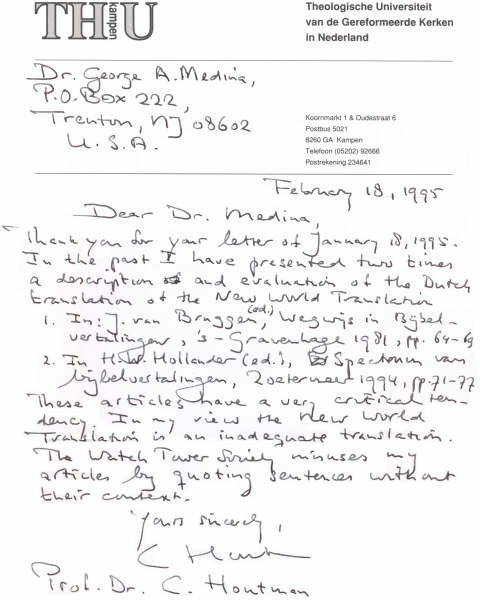
Mr. Houtman notes that on the point of translator bias "the New World Translation of the Jehovah's Witnesses can survive the scrutiny of criticism." (Nederlands Theologisch Tijdschrift, [Dutch Theological Magazines] 38 1984, page 279-280)
-
from a prominent Jehovah's Witness Website
|
Professor
Houtman's article is not about the NWT, but a recent Dutch translation of the
Bible. His tangential reference to the NWT occurs in a portion of
his review in which Houtman expresses his view that while some doctrinal
bias may be present in a variety of translations, it is not as great as
some might suppose. He writes:
"The translator must know the subject.
As we have seen in the past, people expressed distrust of translations
by those belonging to another denomination or religious community,
fearing that theological points of view would affect the translation. When
translations are assessed in a professional manner it must be concluded that only in exceptional circumstances
can one point to passages in which the doctrinal (or political and social) point of
view of the translators can be traced. Even the New World translation of
the Jehovah Witnesses can withstand criticism on this point"
("De Kritiek op de Groot Nieuws Bijbel," Nederlands Theologisch
Tijdschrift, 38, 1984, pp. 279-280).
Click here
for a somewhat longer excerpt from Houtman's article in Dutch, followed
by a rather literal English translation.
Houtman says that the NWT
may withstand criticism on the point that "only in exceptional
circumstances" can one identify bias. He does not claim the
NWT is bias-free, as the JW website implies. Further,
while the article quoted only mentions the NWT tangentially, Professor
Houtman has written two articles that specifically evaluate the NWT -
and in his own words, those articles are "very
critical." Houtman assesses the NWT as follows:
In my view, the New
World Translation is an inadequate translation. The Watchtower
Society misuses my articles by quoting sentences without their
context.5
Thus, it is certainly
incorrect to claim that Professor Houtman endorses the NWT.
|
| George
Howard |
"Thus,
Professor George Howard, of the University of Georgia, U.S.A., made this
comment: 'When the Septuagint which the New Testament church used and
quoted contained the Hebrew form of the divine name, the New Testament
writers no doubt included the Tetragrammaton in their quotations'
(Biblical Archaeology Review, March 1978, page 14).
"The same thing
occurred in the "New Testament," or Christian Greek
Scriptures. Professor George Howard goes on to say: 'When the Hebrew
form for the divine name was eliminated in favor of Greek substitutes in
the Septuagint, it was eliminated also from the New Testament quotations
of the Septuagint. ... Before long the divine name was lost to the
Gentile church except insofar as it was reflected in the contracted
surrogates or remembered by scholars.'"
- "God's Name and
the 'New Testament'", The Divine Name That Will Endure
Forever, WTBTS, 2001)
|
George
Howard's theory has been rejected by most - if not all - modern Biblical
and Textual scholars. In any case, his
theory is that the New Testament authors retained the Tetragrammaton
whenever they quoted verses from the Old Testament that contained it.
His theory thus has no relevance to most of the 237 instances where the
NWT translators inserted "Jehovah" into their "Christian
Greek Scriptures."
Professor
Howard wrote two letters that have been made public which clarify his
position:
The University of Georgia
College of Arts & Sciences
June 5, 1989
Bob Hathaway
Capistrano Beach, CA 92624
Dear Mr. Hathaway:
My conclusions regarding
the Tatragrammaton and the New Testament are:
1) the N.T. writers might
have used the Tetragrammaton in their Old Testament quotations, and 2)
it is possible (though less likely) that the Tetragrammaton was used in
a few stereotype phrases such as "the angel of the Lord."
Otherwise it probably was not used at all. I disagree with the Jehovah
Witness translation that uses Jehovah many times. This goes beyond the
evidence. I do not believe Jesus Christ is Jehovah. If the Jehovah
Witnesses teach this (I’m not aware of most of their theology) they
are off the mark.
Sincerely,
George
Howard
Professor
The University of Georgia
January 9, 1990
Steven Butt
P.O. _____
Portland, ME 04104
Dear Mr. Butt:
Thank you for your letter
of 3 January 1990. I have been distressed for sometime about the
use the Jehovah’s Witnesses are making of my publications. My research
does not support their denial of the deity of Christ. What I tried to
show was that there is evidence that the Septuagint Bibles used by the
writers of the New Testament contained the Hebrew Tetragrammaton. I
argued that it is reasonable to assume that the NT writers, when quoting
from the Septuagint, retained the Tetragrammaton in the quotations. This
does not support the JW’s insertion of "Jehovah" in
every place they want. To do this is to remove the NT from its original
"theological climate." My opinion of the New World
Translation (based on limited exposure) is that it is odd. I suspect
that it is a Translation designed to support JW theology. Finally,
my theory about the Tetragrammaton is just that, a theory. Some of my
colleagues disagree with me (for example Albert Pietersma). Theories
like mine are important to be set forth so that others can investigate
their probability and implications. Until they are proven (and mine
has not been proven) they should not be used as a surety for belief.
Sincerely,
George Howard
For a detailed evaluation of Howard's
study with reference to Watchtower claims, click here.
|
| A.
N. Jannaris |
“a
god” - A. N. Jannaris, Ph.D, author of An
Historical Greek Grammar and Lecturer on Post-Classical and other
Greek dialects at the University of St. Andrews, Scotland (in ZNW 2
[1901], 24-25).
-
from Greg Stafford's second reply to me on the Julius Mantey letter to
the WTB&TS. I had asked Mr. Stafford for a list of scholars
who unequivocally support the NWT rendering of John 1:1.
|
Jannaris
does, indeed, suggest "a god" as the proper translation of theos
in John 1:1c, but in doing so, he does not provide support for the NWT
rendering. Jannaris argued that ho logos did not refer to
the pre-incarnate Son, but rather "that well known oracular
utterance which God made unto (pros) Himself and which having been
instrumental (di' autou) in the creation, is naturally
represented as a creative power, a creator, that is a god, - god
and creator being two synonymous terms" (Jannaris, "Logos," pp.
20-21).
Click here
for the text of a letter to me on the subject of Jannaris and John 1:1
from Dr. Robert Keay of St. Andrews University, Scotland.
|
| Felix
Just |
Prof. Felix Just, S.J. -
Loyola Marymount University, "and god[-ly/-like] was the
Word."
-
from a prominent Jehovah's Witness Website
|
Dr. Just's "Hyper-Literal"
translation of John 1:1 originally read as the Witness website has
it. However, he has revised it as follows:
In origin was the Word,
and the Word was toward [the] God,*
and god/deity/God* was the Word.
In a recently added note, Dr. Just
explains what he was attempting in both versions of his translation:
So what did the Evangelist mean in
John 1:1c? He certainly did not
consider Jesus to be just one "divine being" or
"deity" among many others. If he meant "divine" in
this broader sense, he easily could have used the related Greek
adjective, "ThEIOS," rather than the noun "ThEOS."
(See, for example, the adjective "ThEIOS" used twice in 2
Peter 1:3-4, referring to "divine power" and "divine
nature"). Other texts in John clearly show that the Fourth
Evangelist sees Jesus in a unique relationship with God, calling him
"the only-begotten son" (TON hUION TON MONOGENH; 3:16),
challenging us to believe "in the name of the only-begotten son
of God" (EIS TO ONOMA TOU MONOGENOUS hIOU TOU ThEOU; 3:18),
referring to his glory "as of a father's only son" (hWS
MONOGENOUS PARA PATROS; 1:14), and even calling him "the
only-begotten God" (MONOGENHS ThEOS; 1:18 - another difficult
phrase, with several ancient textual variations).
To summarize: The Fourth
Evangelist may not yet have thought of Jesus as the "second
person of the Trinity" (theological language that took several
centuries to develop in early Christianity - itself strongly influence
by this Johannine passage); yet John certainly thought of Jesus as
"divine" or "deity" or "god" in a unique
sense, not merely "a god," or one deity among many. Exactly
what he meant in John 1:1c may not be easy to understand, and it is
even harder to translate into English because of the difficulties
mentioned above. So rather than fixate on any particular English
translation, even the best of which might confuse us or lead us
astray, we should try to continue deepening our understanding of what
John's entire Gospel says about the uniquely close relationship of
Jesus and the Father.
You can read Dr. Just's translation and
note here.
|
| Benjamin
Kedar |
"In my
linguistic research in connection with the Hebrew Bible and translation,
I often refer to the English edition as what is known as the New World
Translation. In doing so, I find my feeling repeatedly confirmed that
this kind of work reflects an honest endeavor to achieve an
understanding of the text that is as accurate as possible. Giving
evidence of a broad command of the original language, it renders the
original words into a second language understandably without deviating
unnecessarily from the specific structure of the Hebrew....Every
statement of language allows for a certain latitude in interpreting or
translating. So the linguistic solution in any given case may be open to
debate. But I have never discovered in the New World Translation any
biased intent to read something into the text that it does not
contain."
-
The Watchtower, 3/1/1991, p. 30 |
Benjamin
Kedar received his PhD from Yale in 1969, but not in Hebrew. He is
professor of Jewish History at the Hebrew University of Jerusalem.
No doubt, Professor Kedar is knowledgeable about Hebrew, but he is not a
recognized scholar in Biblical Languages.
In a form letter written to those asking
for clarification of his apparent endorsement of the NWT, Professor
Kedar writes:
"A translation is bound to be a
compromise, and as such it's details are open to criticism; this applies
to the NWT too. In the portion corresponding to the Hebrew Bible,
however, I have never come upon an obviously erroneous rendition which
would find it's explanation in a dogmatic bias."
It will be noted that Professor Kedar
limits his comments to the Hebrew Bible. Few scholars have
complained about the Watchtower inserting its dogma into the Hebrew
Scriptures. Indeed, since the OT contains far fewer explicit
Scriptures teaching the orthodox doctrines that
the Watchtower denies - Christ's deity; the existence of the soul; and
hellfire - it is not surprising that
the NWT Hebrew Scriptures are relatively bias-free. Professor
Kedar, of course, says nothing of the relative merits of the NWT
Christian Greek Scriptures.
Professor Kedar's preference for the NWT
Hebrew Scriptures is not shared by other scholars. H.
H. Rowley, an eminent Old Testament scholar from England, wrote
regarding the first volume of the New World Translation Of The
Hebrew Scriptures:
"The translation is marked by a
wooden literalism which will only exasperate any intelligent reader - if
such it finds - and instead of showing reverence for the Bible which the
translators profess, it is an insult to the Word of God" (Rowley,
H.H., "Jehovah's Witnesses' Translation of the Bible" The
Expository Times 67:107, Jan. 1956).
See also the comments of Dr. Goodspeed
as well.
|
| Thomas
O. Lambdin |
Scholar Thomas O. Lambdin in
his work Introduction to Sahidic Coptic says: "The use of
the Coptic articles, both definite and indefinite, corresponds closely
the use of the articles in English." Hence, the Coptic
translation provides interesting evidence about how John 1:1 would have
been understood back then. What do we find? The Sahidic
Coptic uses an indefinite article with the word "god" in the
final part of John 1:1. Thus, when rendered in modern English, the
translation reads: "And the Word was a god."
-
The Watchtower, 11/1/2008, p. 25 |
The first thing to note is that the WT cuts
off the quote mid-sentence. Lambdin goes on to say: "only
exceptions to this general correspondence will be noted in the following
lessons when appropriate" (Lambdin, p. 5). The WT author has
not quoted this scholar 100% accurately and gives the casual reader the
impression that Lambdin actually endorses the "a god"
translation, which he no where does.
Secondly, Lambdin is only speaking of a general
correspondence, he is not going into exhaustive detail. It is true
that Lambdin does not specifically define the indefinite article as
"qualitative;" but this is to be expected from someone writing
an introductory text (few introductory Greek grammars go to this level,
either). Better to consult a more advanced grammar on this matter,
such as Bentley Layton's (see the entry on George
Horner).
While this example is hardly as egregious
as some in this list, it certainly overreaches if its intention is to
provide scholarly support for the "a god" rendering.
Further,
see Brian J. Wright and Tim Ricchuiti, "From
God (QEOS) To God
(NOYTE)" (The Journal of Theological
Studies, NS, Vol. 62, Pt 2, October 2011).
|
| William
Loader |
“a
god” - William Loader, Ph.D. and New Testament Lecturer for the Perth
Theological Hall, Australia, teacher at Murdoch University as a member
of the Perth College of Divinity, and author of several books and
journal articles (in The
Christology of the Fourth Gospel: Structure and Issues [Peter Lang
1992], 155). Loader refers to “a god” as the “most natural reading
of the text.”
-
from Greg Stafford's second reply to me on the Julius Mantey letter to
the WTB&TS. I had asked Mr. Stafford for a list of scholars
who unequivocally support the NWT rendering of John 1:1.
|
Dr.
Loader's book is hardly the unequivocal support for which I was asking
Mr. Stafford. Here is the text of a letter I received from Dr.
Loader on this subject:
Dear Robert
Thank you for your email. I am enclosing in this email the wording of my
book which shows what I was saying in its context and makes it clear that
I would not consider 'the Word was a god' as an appropriate translation.
Context must determine meaning not just choices among possible grammatical
alternatives.
Cheers,
Bill Loader
Dr. Loader is quite liberal in his approach to John's Gospel. He
ultimately defines the relationship of Father and Son as "not in
substantial but in functional terms" (Loader, p. 202).
However, he clearly does not support "a god" as an appropriate
translation of John 1:1c. |
| Jon
Madsen |
J. Madsen, New Testament A
Rendering , 1994, "the Word was a divine Being"
-
from a prominent Jehovah's Witness Website
|
Jon Madsen replies:
"As regards the expression 'divine
being': one should perhaps not too quickly come to the conclusion that
it necessarily means a 'secondary', 'lower', entity than God. As
you are aware, the mystery of the Trinity is just this, that the
'persons' can be both one Being and separate Beings at the same time.
"Thus Christ can say both, 'I and
the Father are One', and 'the Father is greater than I'; further: 'I in
the Father, and the Father in me.'
"To the everyday human mind, these
seem incompatible statements. How very appropriate, therefore,
that we also hear the Comforter (coming from the Father and in the name
of Christ) will 'teach us everything'.
"In other words, a new kind of
thinking is needed which will not only help us 'understand' this mystery
but will 'bring to mind all that Christ said and did', so forming the
basis for the Christian life." (Jon Madsen to Robert Hommel, email
dated 1/27/2006). |
| Julius
R. Mantey |
Careful translators recognize that the articular
construction of the noun points to an identity, a personality, whereas
an anarthrous construction
points to a quality about someone. That is what A Manual
Grammar of the Greek New Testament by Dana and Mantey remarks on
page 140, paragraph vii. Accordingly on page 148 paragraph (3)
this same publication says about the subject of a copulative sentence:
"The article sometimes
distinguishes the subject from the predicate in a copulative
sentence. In Xenophon's Anabasis 1:4:6, ...and the
place was a market, we have a parallel case to what we have in
John 1:1, ...and the word was deity. The article points
out the subject in these examples. Neither was the place
the only market, nor was the word all of God, as it would mean
if the article were used with qeoV."
Instead of translating John 1:1, and
the word was deity, this Grammar could have translated it, and
the word was a god, to run more parallel with Xenophon's
statement, and the place was a market
-
The New World Translation (1971), p. 1362
|
Michael Van Buskirk of the Christian Apologetics: Research and
Information Service (CARIS) wrote to Dr. Mantey (Dr. Dana had died),
asking him if he had been quoted accurately by the Watchtower. Dr.
Mantey replied in a letter dated February 25, 1974. It read:
In response to your request, I give you
the following facts: In Jehovah's Witnesses' Translation of the
New Testament, where I am quoted in a footnote on John 1:1 (cf., D-M
Gk. Gram. Pg. 148 (3)), I was writing on how the article
"distinguishes the subject from the predicate in a copulative
sentence," not on the significance of the absence of the article
before THEOS. My closing statement in the paragraph was:
"As it stands, the other persons of the Trinity may be implied in
THEOS." My interpretation of John 1:1 in that same
paragraph was "The Word was Deity," i.e., that Christ is of
the same essence as the Father, of the same family. So I was
quoted out of context. Is that honest scholarship?
Thus, one of the authors of the Grammar the Watchtower used in
defense of its translation says that he was quoted out of context and
was not even discussing what it quoted him as affirming. Read in
context, Dr. Mantey's comments about the "parallel" cases
refer to two specific points about copulative sentences:
1. If one noun has the article, it is the subject of the
sentence or clause (the place and the word).
2. If only one noun has the article, the sentence is not a
"convertible proposition" (that is, the two nouns are not
interchangeable, as they would be if both nouns have the article).
Thus, place is not interchangeable with market; word
is not interchangeable with Deity.
Dr. Mantey's comments have nothing to do with the semantic force of
the predicate (whether indefinite, as in Xenophon, or qualitative, as in
John 1:1).
Dr. Mantey spoke out forcefully against
the Watchtower's misuse of his Grammar on several occasions,
including a famous letter to the Watchtower Bible & Tract Society
itself. For more information on Dr. Mantey and the Watchtower,
click here. |
| Eilat
Mazar |
"Archaeologist Eilat
Mazar reports unearthing a small clay seal impression, or
'bulla'. It was found in 2005 in a supervised excavation of a
layer dating back to when Jerusalem was destroyed in 607 B.C.E."
- "God's Word
through Jeremiah," WTBTS, 2010
NOTE: Even
though not directly related to the NWT, the 607/586 BC controversy
is so vital to Witness Theology, I wanted to include it here.
|
The WT is wrongly implies Dr. Mazar
supports the 607 date, when she demonstrably does not. This fact
is made clear in the video and in the excerpt from her interview, below.
Here is a selection from the PBS/Nova
interview with Dr. Mazar:
How did the palace of David come to an
end? Have you found evidence in your excavation?
We do not yet have clear evidence of the
destruction. We may in future seasons. But I believe that it was part of
the great destruction of Jerusalem in 586 B.C. by the Babylonians. We
have lots of other evidence of this destruction nearby.
What was some of the first evidence of
the destruction that you and other excavators found in nearby areas?
At the beginning of the 1980s, Professor
Yigal Shiloh, a mentor of mine, excavated an area that includes what is
known as the Burnt Room and the Bullae House. In their destruction
layer, he found pottery typical of this period together with arrowheads
that show that some fight was conducted here. It really revealed the
destruction of Jerusalem by the Babylonians in 586 B.C.
A typical response from a Witness
apologist:
The publication does not cite Mazar as
the source for our belief that Jerusalem was destroyed in 607 BCE.
The publication cites Mazar only as a source of information about the
bulla.
There is no deception at all. Rather, you are knowingly or unknowingly
misinterpreting the information in the publication.
This response is disingenuous.
While factually correct - the WT does not claim outright that Dr.
Mazar supports a date of 607 BCE.for Jerusalem's destruction - it
certainly implies it, given that the 607 date occurs just one sentence
later. One must wonder why it is that the WT must resort to such
obvious tactics. |
| Robert
M. McCoy |
"The translation of
the New Testament is evidence of the presence in the movement of
scholars qualified to deal intelligently with the many problems of
Biblical translation."
-
Andover Newton Quarterly (January, 1963) |
Here are McCoy's comments in full:
"The translation of the New
Testament is evidence of the presence in the movement of scholars
qualified to deal intelligently with the many problems of Biblical
translation. This translation, as J. Carter Swain observes, has its
peculiarities and its excellences. All in all, it would seem that a
reconsideration of the challenge of this movement to the historical
churches is in order (Andover Newton Quarterly, January, 1963).
McCoy, though generally well-disposed
towards the NWT, is not above offering some criticism, which is not
generally included when Jehovah's Witnesses cite McCoy as an
endorsement.
For example, he chides the NWT for
rendering Matthew 5:9 as "Happy are the peaceable" rather than
"the peacemakers:" "One could question why the
translators have not stayed closer to the original meaning, as do most
translators" (IBID).
McCoy continues with a more general assessment of the presence of theological bias in the NWT: "In not
a few instances the New World Translation contains passages
which must be considered as `theological translations.' This fact is
particularly evident in those passages which express or imply the deity
of Jesus Christ."
(IBID).
Mr. McCoy was a graduate of Andover
Newton Seminary. He held degrees of Bachelor of Divinity (1955)
from the Boston University School of Theology, and Master of Sacred
Theology from Andover Newton. Though well-educated, he does not have the
academic or professional credentials of a Biblical scholar, nor is he
recognized as one by those who are. His opinion, of course, is
worth hearing, particularly when all of it is heard. |
| John
L. McKenzie |
John
1:1c "...should rigorously be translated 'a divine being'"
(John McKenzie, A Dictionary Of The Bible). "A divine
being" = "a god."
-
from an online debate with one of Jehovah's Witnesses |
First,
McKenzie states on the first page of his article on "God" that
the God of Israel is "a divine being." He uses the term
"divine being" in reference to Jewish monotheism as referring
to the True God. Thus, MacKenzie is not stating that the Logos is
"a god" or a secondary divinity; he is not using "a
divine being" in the same sense as Witnesses do.
Second, McKenzie seems to have fallen prey to
source critical thought, in that he apparently believes that the
Pentateuch was authored by at least 3 redactors, that there were two
Isaiahs (the latter writing hundreds of years after the first), that
Judaism arose out of pagan polytheism, that el "may"
have been the supreme god of some pre-Jewish Semitic pantheon, that Shaddai
was a supreme "god of the mountain" worshipped prior to
Abraham, and the list goes on. Now, simply because he's liberal in
his approach to the Bible does not mean that McKenzie is wrong, or
should not be considered authoritative with regard to the proper
translation of John 1:1. However, McKenzie certainly has some
presuppositions that influence his beliefs about ancient Judaism (most
of which are contradicted by current scholarship, which has pretty well
laid to rest not only the source critical model, but also the idea that
polytheism antedates monotheism, and the use of El/Elaya/Elohim.
If he believes that the OT is a mélange of several theological belief
systems, some rigidly monotheistic and some henotheistic or even
polytheistic, he will no doubt read ambiguous passages to suit his
beliefs.
Regardless of McKenzie's interpretative
biases (if any), he believes that by "second Isaiah," Israel
had embraced a rigid monotheism, and it is clear that he views Jesus in
this context. Thus, his reference to the Word as "a divine
being" cannot be construed in the fashion Witnesses would like - he
means the phrase exactly as he does of Jehovah in the opening sentence
of his article, and his subsequent comments make clear that he views
Jesus as the embodiment of God on earth, and he cites John 20:28, Col
2:9 and other verses in which Jesus is called ho theos or is
called fully God in other terms |
| James
Moffatt |
John
1:1c: "the Word was divine."
- James Moffatt, A
New Translation of the Bible
"Every honest person
will have to admit that John's saying that the Word or Logos 'was
divine' is not saying that he was the God with whom he was. It merely
tells of a certain quality about the Word or Logos, but it does not
identify him as one and the same God"
-
New Word Translation of the Christian Greek Scriptures,
(1951), pp. 773-774
|
James
Moffatt was an orthodox Trinitarian who supported both the Nicene Creed
and the Chalcedon Confession:
"'The Word was God...And the Word became flesh,' simply means
"The word was divine...And the Word became human.' The Nicene
faith, in the Chalcedon definition, was intended to conserve both of
these truths against theories that failed to present Jesus as truly God
and truly man..." Moffatt, Jesus Christ the Same, (Abingdon-Cokesbury),
1945, p.61.
Moffatt
apparently did believe that "divine" signified that
Jesus was "one and the same God" with ho theos. |
| C.F.D
Moule |
See entry under Westcott, below. |
See
comments under Westcott, below. |
| Archbishop
Newcome |
Newcome,
1808, "and the word was a god"
-
from a prominent Jehovah's Witness website.
The Watchtower has provided a somewhat fuller citation:
"and the word was a god." The New Testament in an Improved Version, Upon the Basis of Archbishop Newcome's New Translation: With a Corrected
Text (SYBT,
p. 27 ).
|
This
citation is actually not from Newcome's translation. Instead, it appears
in a version that was "corrected" by Thomas Belsham and an unnamed Unitarian
Committee using unknown translation principles. Newcome's New
Testament was published in 1796 (click here to see the title page and
Newcome's original translation of John 1:1); the "corrected"
version appeared in 1808.
It is misleading, to say the least, to
imply that Newcome himself (a bona fide Greek scholar) is responsible
for the rendering of a Unitarian Committee whose credentials we are not
able to verify.
|
| Andrews
Norton |
“a
god” - Andrews Norton, D.D. (in A
Statement of Reasons For Not Believing the Doctrines of Trinitarians
[Cambridge: Brown, Shattuck, and Company, 1833], 74).
-
from Greg Stafford's second reply to me on the Julius Mantey letter to
the WTB&TS. I had asked Mr. Stafford for a list of scholars
who unequivocally support the NWT rendering of John 1:1.
|
I
have been unable to locate the 1833 edition of Norton's work, but I have
a revised edition with the same title published in 1880 (Boston:
American Unitarian Association). There is no mention of "a
god" in relation to John 1:1 on page 74 of this edition; however we
find the following discussion regarding the meaning of John 1:1c a bit
later:
"The earlier Fathers understood the
term 'god,' as here used by St. John, in an inferior sense, regarding it
as denoting what we might express in English by saying, that the Logos
was a "divine being.' But this, unquestionably, is not its
true sense. St. John, having just used the word qeoV,
'God,' to denote the Supreme Being, would not in the next clause thus
vary its signification; and corresponding likewise to what I have before
observed, his general use of this term, like that of the other Apostles
and Evangelists, was the same with our own use of the name 'God'"
(Norton, pp. 319-320, emphasis added).
Andrews was a Unitarian who denied the
orthodox interpretation of John 1:1. He argues that the Logos is a
"personification" of the "Power" of God. He
offers the following paraphrase of John 1:1: "In the
beginning was the Power of God, and the Power of God was with God, and
the Power of God was God" (IBID, p. 324). We need not go into
all the reasons why such a view is inadequate; the key point is that
Andrews (at least in the revised edition of his work) does not argue for
"a god" as the proper translation of theos in John
1:1c, and thus does not support the NWT rendering.
|
| A.M.
Perry |
A.M Perry, (theologian),
Journal of Biblical Literature, 1949, pages 329-334 “’John 1:1
indefinite with qualitative force, deity, god…’ a deity, a god”.
-
from a post on a Jehovah's Witness discussion board
|
Here
is a fuller selection of Perry's comments:
| "Definite |
a) Specific, - the
deity, the god (already designated) |
| (ò qeoV) |
b) Personal, - the
Deity, God |
|
c) Generic, - Deity,
God |
| |
|
| Indefinite |
d) Unrestricted, - a
deity, a god |
| (qeoV) |
e) Qualitative, -
deity, god |
...The
generic centers on the class, the qualitative on the instance. And
the qualitative use, particularly when it stands in the predicate, has
nearly the force of an adjective, - as qeoiV
(cf. Jn 1:1)" (Perry, p. 330).
It is true that Perry understands theos in John 1:1c as an
indefinite/qualitative noun, but as such, he does not regard it as
"a deity, a god" as the Witness quote suggests.
|
| JD
Phillips |
J.D. PHILLIPS: (J.D.
Phillips was a Church of Christ Minister, schooled in the original
tongues). "Last week I purchased a copy of your
New World Translation of the Christian Greek Scriptures of which I take
pride in being an owner. You have done a marvelous work...I was happy,
indeed, to see the name Jehovah in it. But you have made a
marvelous step in the right direction, and I pray God that your Version
will be used to His glory. What you have done for the Name alone
is worth all the effort and cost!"
-
from a prominent Jehovah's Witness Website |
It
would be interesting to see Phillip's entire letter. Some
statements have apparently been edited out ("...") and the
statement, "But you have made a marvelous step in the right
direction" seems to indicate some sort of negative prior
comment. In the quote provided, Mr. Phillips is complimentary of
the inclusion of Jehovah in the NWT Christian Greek Scriptures.
This would be an odd compliment for one "schooled in the original
tongues," given that there is no manuscript evidence supporting the
appearance of the Divine Name in the New Testament.
I have been unable to learn much about JD
Phillips, other than his connection with the Church of Christ and a
peculiar dispute over the order of communion. Phillips wrote a
pamphlet advocating his view that a single cup should be used, while
others in his denomination favored a less legalistic approach. In
responding to one of his critics, Phillips commented:
"I assure my readers that it was far
from my intention in writing the tract to indicate anything
"learned" on my part. So far from trying to indicate any
learning on my part, I appealed to the best authorities on language,
such as lexicographers, grammars, concordances, professors of languages,
historians, etc., and then quoted verbatim et Ilteratim. What
education I have was gained in the University of Hard Knocks. In Bro.
G.C. Brewer's review of my booklet in the Gospel Advocate, he
does me an injustice by speaking of the work as a 'show of
learning'" (Old Paths Advocate, 10/1/1936).
Thus, it does not appear that Mr. Phillips
was formally "schooled" in the original languages, and had no
particular skill in them beyond his use of standard lexical works.
His endorsement of the NWT is therefore hardly that of a noted Biblical
scholar.
|
| Charles
Francis Potter |
CHARLES FRANCIS POTTER: "the New World Translation of the
Christian Greek Scriptures...the anonymous translators have certainly rendered the best
manuscript texts...with scholarly ability and acumen." (The Faith Men Live
By [sic], 1954, Page 239)
-
from a prominent Jehovah's Witness Website |
Here
are Potter's comments in full:
"Apart from a few semantic
peculiarities like translating the Greek word stauros as "stake"
instead of "cross", and the often startling use of the colloquial and the vernacular, the anonymous translators have certainly rendered the best manuscript texts both Greek and Hebrew with scholarly ability and
acumen" (The Faiths Men Live By, 1954 [fourth printing,
1955] (NY: Prentice Hall), p. 300).
In the Preface to his book, Potter writes
the following:
"This book is written to help people
appreciate the good in religions other than their own....It is true to
some extent that 'every man grows in error,' but too much stress has
been put on that point by captious critics of religion. In this
book the emphasis is rather on the more inspiring fact that 'every man
glimpses a truth" (IBID, p. v).
Thus, it does not appear that Potter's
intention is to render a critical evaluation of the NWT. His words
must be taken in the context of his attempt to emphasize the
"good" he finds in all religions. We must also consider
what criteria Potter uses to consider the merits he finds in the NWT.
An interesting biography of Potter may be
found here.
The following remarks are excerpted from this source:
He earned a B.D. in 1913 and an S.T.M. in 1917 from Newton Theological Seminary as well as an M.A. from Bucknell in 1916.
Reflecting the continual development of his personal religious thought away from orthodoxy toward more liberalism, Potter founded the First Humanist Society of New York in 1929. The organization stated as its philosophy a "faith in the supreme value and self-perfectibility of human personality, conceived socially as well as individually." The First Humanist Society, whose advisory board included such notables as Julian Huxley, John Dewey, Albert Einstein and Thomas Mann, served as a model and catalyst for other humanist organizations and for the humanist movement in general.
In founding the Humanist Society, Potter left the Unitarian ministry behind and declared that the Society would have no creed, clergy, baptisms or prayers. "I had given up my fast dwindling belief in the deity of Jesus and the doctrine of the Trinity," he wrote. "Now, fifteen years later, I was leaving not only Christianity—if Unitarianism is Christianity—but Theism as well."
With his Humanist philosophy serving as a platform, Potter now became a vocal advocate for social reform, campaigning vigorously against capital punishment, promoting "civil divorce laws," and supporting birth control and women's rights. In 1938 Potter formed the Euthanasia Society of America, which eventually boasted a membership of 40,000 and raised the issue of euthanasia before the American public.
In 1958, soon after the discovery of the Dead Sea Scrolls, Potter published perhaps his most popular book, The Lost Years of Jesus Revealed, an interpretation of the scrolls' contents and their contribution to the understanding of Jesus as a historical figure. Potter also developed an interest in extrasensory perception and telepathy, subjects that were an anathema to other humanists but which Potter believed were of prime concern to Humanism
_____
End of Excerpt _____
Potter's education does not reflect that
of a trained Biblical scholar, and he has not been recognized within the
scholarly community as such. The reader may judge to what degree
Potter's theological "development" influenced his favorable
opinion of the NWT, which (as the full quote indicates) is not entirely
without criticism, despite the stated intention of his book.
|
| Joseph
Priestley |
“a
God” - Joseph Priestley, LL.D., F.R.S. (in A
Familiar Illustration of Certain Passages of Scripture Relating to The
Power of Man to do the Will of God, Original Sin, Election and
Reprobation, The Divinity of Christ; And, Atonement for Sin by the Death
of Christ [Philadelphia: Thomas Dobson, 1794], 37).
-
from Greg Stafford's second reply to me on the Julius Mantey letter to
the WTB&TS. I had asked Mr. Stafford for a list of scholars
who unequivocally support the NWT rendering of John 1:1c.
|
Joseph
Priestley was a noted scientist and Unitarian theologian. He
helped establish the Unitarian church in America. He was Socinian
in his theology, meaning that while he held the Scriptures to be God's inerrant
revelation to Man, nevertheless, Scripture was always to be read in
light of Man's reason. He thus rejected the Trinity and other
orthodox doctrines because he believed them to be counter to
reason. His philosophic commitment to "monism" precluded
any thought of a tri-personal God.
With such presuppositions, it is not
surprising to find that he translates John 1:1 the way he does - it is
not grammatically impossible and is more conducive to his philosophic a
priori.
As a Socinian, Priestley also denied the
pre-existence of the Son. He viewed the Father alone as the
Creator, and passages that speak of the Son as involved in Creation must
be interpreted figuratively:
"These verses, I will venture of
say, are the texts that most strongly favor the notion of Christ's
pre-existence; and no person can doubt but that, if they must be
interpreted to assert that Christ pre-existed at all, they, with the
same clearness, assert that he was the maker of the world. But if
these texts admit to a figurative interpretation, all the other texts,
which are supposed to refer to the pre-existence only, will more easily
admit of a similar construction. These two opinions, therefore,
viz. that Christ pre-existed, and that he was the maker of the world,
ought, by all means, to stand or fall together; and if any person think
the latter to be improbable, and contrary to the plain tenor of the
Scriptures, (which uniformly represent the supreme being himself, without
the aid of any inferior agent or instrument, as the make of the
universe,) he should abandon the doctrine of simple pre-existence also (Priestley,
A General View of the Arguments for the Unity of God; and Against the
Divinity and Pre-Existence of Christ; from Reason, from the Scriptures,
and from History [London: Johnson & Co, 1812, emphasis added).
Thus, while his translation supports the
idea that "a god" is not impossible grammatically, Priestley
does not mean "a God" in the same sense as the Watchtower -
that is, of an "inferior agent or instrument" of
creation. Further, a necessary
presupposition of Priestley's translation is that the Word of John
1:1-3 is not the Son - for if it were the Son, Priestley would admit -
based on the passage quoted above - that He was therefore the Creator,
who is the "supreme being himself." Thus, since
Witnesses do not agree with Priestley's necessary presupposition, they
cannot use him to support their translation - apart from, perhaps,
demonstrating the grammatical possibility of "a God."
In any event, Priestley is not recognized
as authoritative by any modern Greek scholar, no doubt because he wrote
so long ago and did not have the benefit of any of the advances in the
understanding of Koine Greek over the past 100 years. His
views are interesting historically, but carry little weight in the
debate about the proper translation of John 1:1.
|
| A.T.
Robertson |
Here we agree with Dr. A.T.
Robertson when he says: "'God' and 'love' are not convertible terms
any more than 'God' and 'Logos' or 'Logos' and 'flesh.' . . . The
absence of the article here is on purpose and essential to the true
idea." (Page 768, A Grammer of the Greek New Testament).
-
New Word Translation of the Christian Greek Scriptures,
(1951), pp. 775.
|
One
sentence before the Watchtower quotation, we find the following:
"It is true also that o qeos hn
o logos (convertible terms) would
have been Sabellianism."
Thus, the very thing - the presence of the Greek article - that
the Watchtower insists should be there to support the doctrine of the
Trinity, A.T. Robertson writes should not be there, lest it teach
a form of Modalism.
|
| Robert
Harvey Strachen |
John 1:1c:
"divine, a divine being" (Robert Harvey [sic], The
Historic Jesus in the New Testament).
-
from a prominent Jehovah's Witness Website |
The
correct reference for this quote is Robert Harvey Strachen, The
Historic Jesus in the New Testament, Student Christian Movement
Press: London, 1931, p. 187).
If one reads Strachen's comments in
context, it becomes obvious that by "divine," he is referring
exclusively to the Divine Nature of the true God:
"These he [the Hebrews author]
revealed as the divinely-ordained preparation of Jesus for the office of
High Priest.
"The whole story of the life of
Jesus is recast [by John] and reinterpreted as the manifestation in time
of the Eternal Logos.
"We have at the very outset that the
'Logos' was 'in the beginning' and that he was a divine being (theos).
"The Eternal Word has uttered itself
finally in the historical person, Jesus Christ...His words are
'signs' of the Divine Presence" (Strachen, p. 187).
Strachen goes on to say:
"The bare words 'I am' are put in
the mouth of Jesus in the saying, 'Before Abraham was, I am,' and it is
obvious that a reference is intended to the utterance of God to Moses at
the burning bush. As the Logos, the Divine Word, Jesus naturally
utters himself" (p. 189).
Thus, while Strachen's words may be taken
out of context to substantiate the NWT rendering of John 1:1c, one
cannot do the same with Strachen's meaning. Strachen regarded the
"divine being" of the Logos to be eternal, the Divine Word,
the "I am" of the burning bush.
|
| Johannes
Schneider |
"Und
Gottlicher Art war der Logos.
"and godlike sort
was the Logos.
"Das Evangelium
nach Johannes, Johannes Schneider"
-
New World Translation, 1984, Appendix 6A. |
The
Watchtower's English translation is highly misleading. The term
"Gottlicher Art" (Literally: "Godlike/divine kind")
is better translated "divine nature." See comments on Siegfried
Schultz for more information. |
| Siegfried
Schultz |
"ein
Gott (oder: Gott von Art) war das Wort.
"and a god (or, of a
divine kind) was the Word.
"Das Evangelium
nach Johannes, Siegfried Schultz"
-
New World Translation, 1984, Appendix 6A. |
The
Watchtower's English translation is misleading. The
term "von Art" (literally: "from/by kind") is
idiomatic German for "by nature" or "in essence."
Martin Luther used the term "Gott von Art" of Jesus in his
hymn, "Nun komm der Heiden Heiland" ("Now Come, Savior of
the Gentiles"):
Gott
von Art und Mensch ein Held
By
nature God and Man, a hero
Certainly, Luther would never have
written that Jesus was "of a divine kind," any more than he
would have written that He was "of human kind."
"Von Art" is commonly used by German Bible scholars to signify
what Harner defines as a "qualitative" sense. That this
is the meaning Schulz intends, we need look no further than his commentary on John
1:1:
"The third phrase sets forth the
basic premise concerning the pre-existent "Word": "and
God was the Word" (German: und Gott war das Wort). In verse
1c "God" stands in contrast to the clearly articulated divine
concept in verse 1b emphasized at the beginning by lack of the
article...In so much as the last word of verse 1b was dealt with, the
whole imparts a divine being to the "Word". The obvious
"and God" is the predicate and in no way identifies the Word
with the latter "with the God." Thereby "the
Word" is identified as "God" just as the other one is,
with which this "Word" stands in close association. The Deity [German:
Gott-Sein, literally "God-Being"] denotes the essence of the
"Word" as it does God himself. The word "God"
in the predicate of verse 1c is not the subject - as in Luther's
translation "God was the Word," on the contrary it is the
predicate. The "Word" is not "the God" (verse
1b) or God the Father. Likewise, Logos is "Gott von
Art," divine essence, essentially equal to God, so that one has to
translate them interrelatedly: "and the Word was God by
nature." The religious traditions of monotheism in the Old Testament
and the late Jewish period are supported and honored by this pre-Johannine,
Hellenistic eulogy. In no way, however, as we have already stressed, is
a simple inter-identification to be had."
Thus, Schulz says that The Word is
"identified as 'God' just as the other one is" (i.e., just as ho
theos is), and "essentially equal to God." Schulz
is not saying that the Word is "a god," in the sense one might
think by just looking at the literal English translation of "ein
Gott," but rather is very clearly distinguishing the Logos from the
Father, yet emphasizing that His "divine essence" is that of ho
theos, and thus is equal in nature to God - which, of course,
supports the Trinitarian view of what qualitative theos means in
John 1:1c. |
| William
Carey Taylor |
"Just
when the infidel universities of this land thought they had laughed out
of court the very Name Jehovah, up surges...Jehovah's Witnesses...and
with considerable scholarship they get out their own New Testament and,
lo and behold, they put Jehovah into the New Testament two or three
hundred times...it ought to be there many times" (The New Bible:
Pro and Con, p. 75).
-
from a prominent Jehovah's Witness Website |
The
New Bible: Pro and Con is a
polemical analysis of the Revised Standard Version, in which the
Baptist Taylor finds many more "cons" than
"pros." The section from which this quote appears is
entitled: "Jehovah - The Completely Banished Word."
Taylor laments the RSV's complete removal of JEHOVAH from its text, in
favor of LORD or GOD. Taylor's overall tone can be surmised from
the conclusion he draws just prior to the quoted passage:
"This blackout [of the Divine Name], a vindictive intolerance of
God himself as revealed, is a scandal before the bar of the American
conscience" (Taylor, p. 75).
Taylor continues:
"Sometimes God chastens his people
with pagans. Just when the infidel universities of this land
thought they had laughed out of court the very Name Jehovah, up surges
that plebeian and outrageous movement the Name as their name, 'Jehovah's
Witnesses.' And they gather in assemblies under the very shadow of
Columbia University, one hundred and twenty thousand strong. And
they baptize (real meaning of the word, too) over three thousand
converts to their Jehovah one day, and next year over four thousand in a
day. And one of their lawyers goes before our august Supreme Court
and defies the Catholic judge on it to hold back their liberties, and
that judge votes for him. And with considerable scholarship they
get out their own New Testament and, lo and behold, they put Jehovah
into the New Testament two or three hundred times. And then our curious
America says: 'What's it all about? I bought a copy of the new
Bible [the RSV]. But I didn't find that word even in it. How
come, professor? Weren't you on that committee of
translators?' Then will the professor-translator have to confess:
'We are guilty of suppression of that Name. It ought to be there
many times. We banished it, from professorial pride and
self-sufficiency. And God has judged us with these pagan
barbarians and brought it back into the thought of all people. We
ought not to have made that wrong and arbitrary decision. The next
Bible, I assure you, will not repeat our folly.' God said: 'This
is my name forever, and thus I am to be remembered throughout all
generations' (Ex. 3:15). No. Not to the generation of
readers of the RSV. But wait a minute. Enter Jehovah's
Witnesses. He is remembered, in judgment if not in grace"
(Taylor, pp. 75-76).
Taylor, quite clearly, is not endorsing
the scholarship of the NWT, beyond its inclusion of the Divine
Name. Even here, it cannot be said that he approved of the use of
the Divine Name in the NWT Christian Greek Scriptures - beyond
the fact that it raised the issue of the Divine Name in Bible
translation to the public's attention. Indeed his "it ought
to have been there many times" refers to the "the new
Bible" as a whole, not the New Testament.
Taylor's work is more polemical than
scholarly; for example, his complaint that Paul's salutation to the
saints "at Ephesus" has been placed in a footnote: "Can
you beat this?...This address, I say, has been dropped down to the
margin and put on the same level with so much spurious stuff"
(IBID, p. 76). Taylor seems unaware that three early MSS of
Ephesians lack this phrase. Thus, Taylor's credentials as a Bible
scholar are questionable, at best. Be that as it may, with the
numerous attacks Taylor levels at far less offensive translations in the
RSV, one can only speculate what Taylor would have said about the more
controversial translations in the NWT. |
| Vincent
Taylor |
"Here,
in the Prologue, the Word is said to be God, but as often observed, in
contrast with the clause, 'the Word was with God', the definite article
is not used (in the final clause). For this reason it is generally
translated 'and the Word was divine' (Moffatt) or is not regarded as God
in the absolute sense of the name. The New English Bible neatly
paraphrases the phrase in the words 'and what God was, the Word
was',....In neither passage is Jesus unequivocally called God...."
("Does the New Testament Call Jesus God?", Expository Times,
73, No.4 [Jan.1962], p.118).
-
from a post on a Jehovah's Witness discussion board |
Here
are Taylor's comments in full:
"We
reach a more difficult issue in the Gospel of John. Here, in the
Prologue, the Word is said to be God, but, as often observed, in
contrast with the clause, 'the Word was with God', the definite article
is not used (in the final clause). For this reason it is generally
translated 'and the Word was divine' (Moffatt) or is not regarded as God
in the absolute sense of the name. The New English Bible neatly
paraphrases the phrase in the words 'and what God was, the Word was'.
In a second passage in the Prologue the textual evidence attests
'only-begotten God' more strongly than 'only-begotten Son', but the
latter is preferred by many commentators as being more in harmony with
johannine usage and with the succeeding clause, 'who is in the bosom of
the Father'. In neither passage is Jesus unequivocally called God, while
again and again in the Gospel He is named 'the Son' or 'the Son of God'.
In a third passage, however, there is no doubt that the name 'God' is
assigned to Him. When Thomas is bidden to see the hands and side of
Jesus, he cries in adoring love, 'My Lord and my God'. This cry is
spontaneous and devotional and illustrates an aspect, and not the whole,
of the Evangelist's Christology. Like the author of Hebrews he thinks
and speaks of Christ in the category of Sonship" (Taylor, "Does
the New Testament Call Jesus God?", Expository Times, 73,
No.4 [Jan.1962], p.118, emphasis added).
Witnesses often assume that the rendering
"The Word was divine" supports their view; however, most
scholars who consider theos to be adjectival in this verse,
understand "divine" to signify the nature of the one True
God. It is clear that Taylor understands "divine" in
this way when he lauds the NEB paraphrase, for what God was (divine
nature of the True God) the Word also was. |
| Rijkel
ten Kate |
New World Translation Impresses a Scholar
ACCORDING to classical Greek scholar Dr. Rijkel ten Kate,
Dutch Bible translations fail to render certain words accurately. For example, in Luke chapter 2, we find three
different Greek words (bre'phos, pai·di'on, and pais) employed to describe the successive stages of Jesus' growth.
Each of these words has a different shade of meaning.
However, in many Bibles, two or all three of these words are vaguely rendered "child." What is the correct translation?
Dr. ten Kate explains that in Lu 2 verse 12 the Greek word
bre'phos means "a newborn, or baby." Pai·di'on, used in Lu 2 verse 27, means "little boy or child," and
pais, found in Lu 2 verse 43, should be rendered "boy." "As far as I know,"
wrote Dr. ten Kate in the March 1993 issue of Bijbel en Wetenschap (Bible and Science), "not one Dutch translation
has rendered this adequately, that is to say, completely in harmony with the original text."
Later, Dr. ten Kate was shown the New World Translation of the Holy Scriptures, which is available in 12 languages,
including Dutch. His reaction? "I am very surprised," he said, "that there is actually one Dutch Bible in which the
different use of the three Greek words bre'phos, pai·di'on, and pais is rightly taken into account." Does the New World
Translation translate these verses in harmony with the original Greek text? "Completely in agreement," responds Dr.ten Kate.
-
The Watchtower, 4/15/95, p. 32 |
This
article has been quoted by a number of Witness apologists, and is
referenced in an online article
comparing the NWT with the NIV and NASB.
Ten Kate's comments, of course, center on the three Greek words meaning "baby," "child" or "boy" in Luke 2.
It may be that the NWT is more accurate in this verse than other Dutch
versions, but the same does not hold true with the NWT compared to other
English Bibles. Both the NASB and NIV render the three Greeks words correctly, per ten
Kate; and the KJV makes the distinction in 2 of the three cases
(it renders Luke 2:43 as "child" - "child," of course, is non-adult, synonymous with
"boy").
Other
English versions that render these three words as Dr. ten Kate suggests
are the RSV, ESV, Darby, and the ASV. Young's Literal follows the
KJV.
We may applaud the NWT for rendering these three words of no theological
significance accurately in Dutch. However, to imply that ten
Kate's comments support the NWT apart from this specific context is
implying too much.
When
asked to comment on the WT article, Ten Kate's reply is as follows:
I
can reassure you it has never been my intention or purpose the declare
that the whole translation of the Watchtower Society is right and an
adequate translation. Only the cited verses in Luke 2 .... What
about the whole Bible: I did not read their edition, so I cannot
give a judgment about it....so, their article, "New World
Translation Impresses a Scholar" is exaggerated in its title.6
|
| John
Thompson |
"and
the Logos was a god." John S. Thompson, The Monotessaron; or,
the Gospel History, According to the Four Evangelists, 1829.
-
Kingdom Interlinear Translation (1985), p. 1139. |
Mr.
Thompson claimed to be directed by
"some being" who entered his room at night and directed him: "in all your writings, be careful to represent Jesus as only
the instrument of God in all he does" (American Quarterly Review,
1830, Vol. 8, pages 227-245). You can find an extended quote here.
For more information, see Witnesses of
Jehovah by Leonard and Marjorie Chretien, p. 169-171. |
| Alexander
Thomson |
"The
translation is evidently the work of skilled and clever scholars, who
have sought to bring out as much of the true sense of the Greek text as
the English language is capable of expressing" (Alexander Thomson
in The Differentiator (April 1952, pp. 52-57).
-
Awake! March 22, 1987, p. 14. |
Thomson
had no formal training in Greek or Hebrew. He published several
articles on the NWT in The Differentiator, apparently a privately
published journal that appeared briefly in the 1950's. The
Differentiator is not considered a scholarly journal - indeed, I
have been unable to locate a single copy in print or on microfilm - and
there is no evidence that it was so considered during its
publication.
Thomson later wrote that while he
generally endorsed the NWT, he found it to be "padded with many
English words which had no equivalent in the Greek or Hebrew" (The
Differentiator [June 1959], cited in Ian Croft, "The
New World Translation and Its Critics").
Thus, Thomson does not appear to have
been a recognized scholar in Biblical Languages, his review of the NWT
was not published in a scholarly journal, and his endorsement is not
quite as positive as the Watchtower might hope. |
| C.C.
Torrey |
And
The Four Gospels—A New Translation, by Professor Charles Cutler
Torrey (second ed., 1947), says: "In the beginning was the Word,
and the Word was with God, and the Word was god. When he was in the
beginning with God all things were created through him ; without him
came no created thing into being." (John 1:1-3) Note that what the
Word is said to be is spelled without a capital initial letter, namely,
"god."
- Aid to Bible
Understanding (1969), pp.1669
|
Two
editions of Torrey's Gospels were published in 1933. One
reads "and the Word was god" and the other reads "and the
Word was God." I have been unable to ascertain the reason of
the change. The revised edition in 1947 reads "god."
So far as I know, Torrey never indicated
publicly his reasons for "god" with a lowercase
"g." It may be, as Unitarian writer Anthony Buzzard
asserts, that Torrey's intention was to indicate that the Word had the
quality of God without being equated with God. If this is the
case, Torrey could be viewed as supporting the traditional understanding
of John 1:1c, for while Trinitarians assert that the Word was fully God,
He is not 100% equivalent to the Father with whom He was in the
beginning.
In any case, Torrey cannot legitimately
be used as an authority to support the NWT's "a god"
translation without further clarification of what Torrey meant.
Here is the bibliographic information for
Torrey's translation from The
Bible Researcher website:
1933.
Charles Cutler Torrey, The Four Gospels, A New Translation. New
York: Harper and Brothers, 1933. Revised 1947. Based on Torrey's
reconstruction of hypothetical Aramaic documents underlying the Greek
Gospels.
You will notice that Torrey bases his
text on "hypothetical" Aramaic documents. As he states
in his Preface:
"The Aramaic Gospels, both the
originals and the copies made from them, perished utterly, not even a
fragment is known to have survived."
Not only is the Aramaic origin of the
Gospels highly disputed by scholars, it is doubtful that such a work
(based as it is upon "retroversion" of Greek into the purported
underlying Aramaic) could even loosely be considered a
"translation." |
| W.
E. Vine |
"Literally,
'a god was the Word'
-
from an email dialog with the webmaster of the now-defunct Trinity
Exposed Website. |
Here
are Vine's comments in full:
"'and
the Word was God'; here a double stress is on theos, by the
absence of the article and by the emphatic position. To translate
it literally, 'a god was the Word,' is entirely misleading" (Vine, Vine's
Complete Expository Dictionary, "God", p. 272).
"Literally" merely signifies that "a god" is
possible from the standpoint of grammar alone; a "literal"
translation is not necessarily an accurate one, and other
"literal" translations are possible, including the traditional
rendering (see entry for Murray J. Harris, above).
|
| J.
W. Wenham |
"as
far as grammar alone is concerned, John 1:1c could mean either, 'The
Word is a god', or 'The Word is the god' (The Elements of NT Greek.
See p. 35, note 1. Wenham is another who rejects the "a god"
rendering because of theology ).
-
posted by one of Jehovah's Witnesses on an Internet discussion board |
Here
are Wenham's comments in full:
"In
ancient manuscripts which did not differentiate between capital and
small letters, there would be no way of distinguishing between QeoV
('God') and qeoV
('god'). Therefore as far as
grammar alone is concerned, such a sentence could be printed: qeoV
estin `o LogoV, which would mean
either, 'The Word is a god', or, 'The Word is the god'. The
interpretation of John 1.1 will depend upon whether or not the writer is
held to believe in only one God or in more than one god" (Wenham, The
Elements of New Testament Greek, p. 35, n. 1).
We may add Wenham to the list of scholars
who acknowledge that "a god" is not a grammatical
impossibility. If Wenham is cited to counter such a claim, we
cannot find fault with such a citation.
However, the claim that Wenham rejects
"a god" simply on the basis of his theology is
questionable. Wenham says he rejects "a god" because of
John's theology, not his own. While Wenham's theology may color
his perspective of John's, there are numerous other elements that shape
our understanding of John's theology. These elements include one's
interpretation of the remainder of John's Gospel, his other writings,
the NT as a whole, the history of Jewish religious beliefs and
practices, the works of the early church fathers, particularly those
with a connection to the Evangelist, and much more.
Further, Wenham also acknowledges that
"the Word is God" is grammatically possible (since that is the
way he translates theos estin ho Logos earlier on this page), and
we may characterize those who reject this rendering as doing so on the
basis of their theology.
|
| Paul
Wernle |
“a
God” - Paul Wernle, Professor Extraordinary of Modern Church History
at the University of Basil (in The
Beginnings of Christianity, vol. 1,
The Rise of Religion [1903], 16). -
from Greg Stafford's second reply to me on the Julius Mantey letter to
the WTB&TS. I had asked Mr. Stafford for a list of scholars
who unequivocally support the NWT rendering of John 1:1c.
|
Here
are Wernle's comments in full:
"It
is important to realize clearly the distinctive feature in the Jewish
faith in God. It cannot be monotheism. For a long time past
that had become the common property of the enlightened Greek world, as
far as it had any understanding for religion, and even in Israel itself
it had been modified by a belief in angels which bears clear marks of
its polytheistic origin. One need read, for instance, the Epistle
to the Colossians if one would form some idea of the weakness of Jewish
monotheism, not to mention the Greek prologue to the Fourth Gospel,
which places 'a' God, the Logos, by the side of 'the' God" (Wernle,
p. 16).
Wernle may have been a professor of
modern Church history, but that does not make him a recognized scholar
of Biblical Languages. I'm unaware of a single scholar who has
cited Wernle as authoritative with regard to the proper translation of
John 1:1, and no Witness apologist I have asked has produced
one.
Wernle did not have the benefit of
Colwell or Harner's studies, nor the subsequent scholarship that bears
on the proper translation of John 1:1c. His opinion is interesting
from an historical perspective, but is of little value in determining
the proper translation of John 1:1c, beyond perhaps demonstrating that
"a god" is not impossible grammatically.
Wernle's work is heavily influenced by
the long-defunct "History of Religions" school, popularized in
the 19th Century by Wrede and Bousset, which posited a polytheistic
origin for Judaism and the influence of Greek philosophy on the NT
writers. Wernle argues that the Prologue of John's Gospel is
"Greek," that is to say, Platonic or Philonic, rather than
essentially Jewish, as is generally believed today. With such
presuppositions, it is not surprising that Wernle chooses to interpret
John 1:1c in a polytheistic fashion. |
| B.F.
Westcott |
Bishop
Westcott, coproducer of the noted Westcott and Hort Greek text of the
Christian Scriptures says: "It is necessarily without the
definite article inasmuch as it describes the nature of the Word and
does not identify his person." (Quoted from page 116 of An Idiom
Book Of New Testament Greek, by Professor C. F. D. Moule, 1953 ed.).
-
from Aid to Bible Understanding, p. 919, in support of the NWT
rendering of John 1:1 |
Here
are Westcott's comments in full:
"On
the other hand it needs to be recognized that the Fourth Evangelist need
not have chosen this word-order, and that his choice of it, though
creating some ambiguity, may in itself be an indication of his meaning;
and Westcott's note (in loc.), although it may require the
addition of some reference to idiom, does still, perhaps, represent the
writer's theological intention: 'It is necessarily without the article (theos
not ho theos) inasmuch as it describes the nature of the Word and
does not identify His Person. It would be pure Sabellianism
to say "the Word was ho theos". No idea of
inferiority of nature is suggested by the form of the expression, which
simply affirms the true deity of the Word. Compare the converse
statement of the true humanity of Christ v. 27 (hoti hious anthropou
estin...).'" (Moule, p. 116, emphasis added).
Neither Moule nor Westcott support the NWT's rendering of John 1:1c. |
| Allen
Wikgren |
(Allen
Wikgren was on the New Revised Standard Version committee, as well as on
the committee which produced the UBS Greek text).
"Independent
readings of merit often occur in other modern speech versions, such
as...the Jehovah's Witnesses edition of the New Testament (1950)."
(The Interpreter's Bible, 1952 Vol. 1 page 99)
-
from a prominent Jehovah's Witness Website |
Here
are Wikgren's comments in full:
"Independent
readings of merit often occur in other modern speech versions, such as
Verkyl's New Testament (1945) and the Jehovah's Witnesses edition of the
New Testament (1950)" (The Interpreter's Bible, 1952 Vol. 1 page
99).
Dr. Wikgren was quoted accurately and
completely. That is to say, he does not go on to define which
"independent readings" of the NWT he finds to be "of
merit." We do not know what Dr. Wikgren thought about the
NWT's more controversial renderings, such as John 1:1 or Colossians
1:16.
Dr. Wikgren, referring to all of the
modern English versions he has been discussing says this: "A free,
idiomatic rendering is not concerned about literal meanings"
(IBID). Thus, his endorsement may be less than Witnesses would
like.
Verkyl's New Testament (also known as the
New Berkley Version) reads "and the Word was God" for
John 1:1c, and does not insert "other" into the text of
Colossian 1:16. None of the dozen or so other modern
English versions Dr. Wikgren discusses render these verses as does the
NWT. It is therefore unlikely
that Dr. Wikgren would include the NWT readings of these verses among
those he considers meritorious. |
| Benjamin
Wilson |
1864: "and a god was the word." The Emphatic Diaglott, interlinear reading, by Benjamin Wilson.
-
SYBT, p. 27. |
We
may first note that Mr. Wilson was not formally trained in Greek.
He appears to have been a follower of John Thomas, the founder of the
Christadelphian movement.
The views of a 19th Century Unitarian are
interesting from an historical perspective, but not convincing in
demonstrating the proper translation of John 1:1c. Wilson did not
have the benefit of the advances in the understanding of Koine
Greek that emerged over the past 100 years; he did not have Colwell or
Harner's studies available to him, nor the subsequent scholarship that
bears on the subject.
Wilson is not regarded as authoritative
by modern Biblical scholars. Interestingly,
the actual text of the Diaglott reads:
"In the beginning was the Logos, and the Logos was with God, and the Logos
was God"
This obviously supports the traditional rendering.
However,as the Watchtower notes, in the interlinear we find:
"In a beginning was the Word, and the Word was with the God, and a god was
the Word."
Now by using the Diaglott as a support for 'a god,' Witnesses argue that the interlinear translation is to be preferred over the text.
However, Witnesses do not follow this
same approach with the KIT.
The interlinear translation in the KIT reads:
"In beginning was the Word, and the Word was toward the God, and god was
the Word." (The use of the small "g" is, of course, not
based on the Greek, as the older manuscripts did not distinguish between
capital and lower case letters).
Witnesses may choose to resolve this
apparent inconsistency by arguing that the translation principles
practiced by Wilson and the NWTTC are not the same; however, this claim
would need to be substantiated - on the surface, it would appear that in
general terms, both texts seek to provide a 'literal' translation in the
interlinear and a clear, idiomatic translation in the text.
When one considers that Wilson denied
that the Word was the pre-existent Son of God, it becomes clear how he
could view the "literal" Greek as being "a god,"
(indicative of the noun being anarthrous),
and "God" being the proper translation - for if the Word is
the Foreknowledge, Wisdom, and Power of God (as opposed to the Person of
the Son), Wilson - like other Unitarians (such as Andrews
Norton) - could view these attributes as pertaining to the Supreme
Being Himself.
In any event, using Wilson to support the
NWT is problematic in the extreme, given that Wilson translated
John 1:1c as "The Logos was God." |
| Thomas
Winter |
(Thomas
N. Winter taught Greek at the University of Nebraska).
"I think it is a
legitimate and highly useful aid toward the mastery of koine (and
classical) Greek. After examining a copy, I equipped several interested
second-year Greek students with it as an auxiliary text. After
learning the proper pronunciations, a motivated student could probably
learn koine from this source alone. ...the translation by the anonymous
committee is thoroughly up to date and consistently accurate. ...In sum,
when a witness comes to the door, the classicist, Greek student, or
Bible student alike would do well to place an order." (The
Classical Journal, "The Kingdom Interlinear", April-May 1974,
pages 375, 376)
-
from a prominent Jehovah's Witness Website |
Mr.
Winter's positive comments are almost all directed towards the literal
translation in the KIT - very little is said of the NWT. The
literal translation in the KIT is generally very good and often may be
used to demonstrate problems with the NWT translation. Mr. Winter
also liked the layout of the KIT, with the English word appearing below
the Greek word, rather than in a side column - which is how the
classical Greek interlinears to which Mr. Winter compares the KIT are
laid out. The fact that Mr. Winter seems unaware of identically
laid out Interlinear Bibles, such as those published by Zondervan
featuring the literal translation of Alfred Marshall, would seem to
indicate that he was more familiar with classical Greek resources than
those for Biblical Greek.
Indeed, Mr. Winter was trained in and
taught classical Greek. His familiarity with Biblical Greek is
unknown, and he is not recognized as an authority on the subject by
Biblical Greek scholars.
Mr. Winter later wrote, "I am not
happy with the use now being made of the review," and he went on to
note a few problems, such as Jesus' words in John 8:58 (which NWT
translates as "I have been"). Winter commented, "No way
to go here but 'I am'" (Thomas N. Winter, in a letter to M. Kurt
Goedelman of Personal Freedom Outreach, dated 3 October 1980). |
| Robert
Young |
“a
God” - Robert Young, LL.D. (in his Concise
Commentary on the Holy Bible [Grand Rapids: Baker, n.d.], 54).
-
from Greg Stafford's second reply to me on the Julius Mantey letter to
the WTB&TS. I had asked Mr. Stafford for a list of scholars
who unequivocally support the NWT rendering of John 1:1c.
|
Here
are Young's comments in full:
"John
1:1 And the Word was God, ] more lit. 'and a God (i.e.,
a Divine Being) was the Word,' that is, he was existing and recognized
as such" (Young, Concise Critical Comments on the Holy Bible).
It is doubtful Dr. Young intended his
words to support something akin to the NWT rendering, "The Word was
a god." Young was a member of the Free
Presbyterian Church of Scotland at a time when some of the more liberal
members of that church were questioning the adherence to the Westminster
Confession as their defining rule of faith. Young was
staunchly in the conservative wing that upheld the Confession.
Some, like Fergus Ferguson, were bought under scrutiny by the leaders of
the Free Church for (among other things) advocating anti-Trinitarian
views. That someone as prominent as Young could remain in the
conservative wing of the orthodox Free Church and have advocated Christ
as a secondary "god" is unlikely (1).
It is significant that Young capitalizes
"God" and "Divine Being" in his commentary.
His definition of theos reads "God, a god." In
the list of verses which follow, "God" with a capital is the
true God, while lower-case "god" is a pagan god or
idol.
Further, Young says that this
"God" was "existing" in the timeframe of "the
Beginning" which he defines as "the beginning of
creation." Thus, it seems clear that Young believed John 1:1c
pointed to the Word as "a" God that was already existing when
creation began.
Finally, Young's own "literal"
translation of John 1:1 reads, "And the Word was God."
Thus, regardless of what Young may mean
by the indefinite article, it seems probable that he understood theos
in this context as signifying "God" in an underived and
absolute sense.
The rendering "a God" is
probably Young's attempt to indicate the absence of the article in the
Greek ("more lit."). It allows him to emphasize
the distinction between Jesus as "a Divine Being" and the
"great God" of John 1:1b, and also their unity as truly
Divine, existing together before all creation. While Young
provides Witnesses with a reputable Greek scholar that proves that anarthrous
theos in Greek may be "literally" rendered as an
indefinite noun (just as it can be "literally" rendered a
definite or qualitative noun), there is little evidence Young understood
John 1:1c as anything like the NWT rendering, "a god,"
a secondary divine being who was created "in the
Beginning." |